
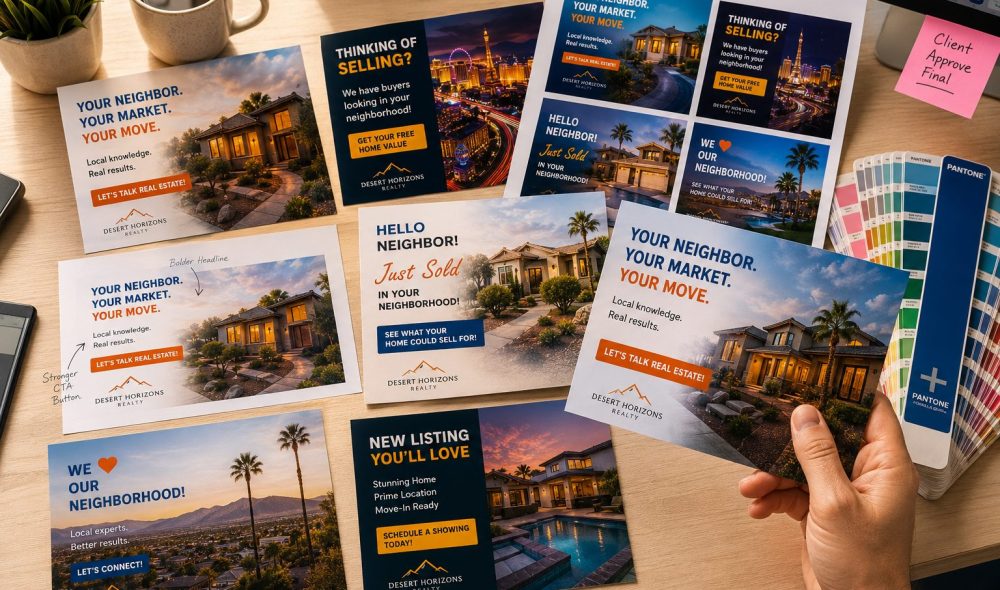
Postcard marketing remains one of the most powerful, most measurable, and most cost-effective tools in the modern marketing playbook yet many businesses underutilize it or execute it poorly. When done right, postcard marketing strategies deliver response rates, conversion rates, and returns on investment that digital-only marketers can only envy. The secret is not simply printing a postcard and mailing it, it is understanding the design principles, targeting strategies, offer structures, and mailing best practices that separate high-performing postcard campaigns from those that end up in the recycling bin. This guide gives you the complete framework for postcard marketing that actually generates results.
Why Postcard Marketing Strategies Outperform Other Direct Mail Formats
Among all direct mail formats, postcards consistently achieve the highest engagement rates and the reason is beautifully simple. A postcard requires no envelope to open. The moment a recipient picks up their mail, your message, your offer, and your brand are all immediately visible. This zero-friction exposure means your marketing message reaches 100% of the people who receive your mail piece no envelope, no barrier, no decision to open.
Effective postcard marketing also benefits from the tangibility advantage of physical mail. In a world where the average person sees thousands of digital ads per day, a well-designed physical postcard stands out precisely because it is not on a screen. Recipients handle it, feel it, and often set it aside to reference later a behaviour that simply does not happen with digital ads.
Business postcard marketing is versatile enough to serve virtually any business goal: generating new customer leads, reactivating lapsed clients, announcing promotions, driving website traffic, supporting seasonal campaigns, or reinforcing brand awareness in a target geographic area.
Effective Postcard Marketing: The Design Principles That Drive Response
Headline and Offer: The Most Critical Elements
Effective postcard marketing begins with an irresistible headline and a clearly stated offer. You have approximately three seconds to capture attention before a postcard is sorted into keep or discard. Your headline must immediately communicate a specific benefit or create enough curiosity to make the recipient want to read more.
Postcard advertising tips consistently emphasize that your offer should be specific, time-limited, and valuable enough to motivate action. Vague messages like ‘Call us for your printing needs’ dramatically underperform compared to specific offers like ‘Save 20% on your first order offer expires [date].’ The more specific and compelling your offer, the higher your postcard marketing strategies will perform.
Visual Design That Commands Attention
The visual design of your postcard must work in harmony with your headline. Use one dominant image that supports your offer a product shot, a before/after image, a powerful lifestyle photo, or a graphic that immediately communicates your category. Avoid cluttering your design with too many images or too much text. Postcard design strategies built on clean, focused layouts consistently outperform busy, information-dense designs.
Color psychology plays a significant role in effective postcard marketing. High-contrast color combinations (dark text on light backgrounds, or light text on bold color backgrounds) increase readability and impact. Your brand colors should anchor the design, but accent colors can be used strategically to draw the eye to your headline, offer, and call to action.
The Back of the Card: Your Secondary Sales Message
Most postcard marketing strategies focus heavily on the front of the card but the back is equally important. Many recipients flip a postcard over to check the sender information and indirectly read any secondary messaging placed there. Use the address side of your postcard to include social proof (testimonials, star ratings), a secondary offer, a QR code, or additional product information that supports your primary message.
Postcard Mailing Best Practices: A Checklist for Campaign Success
- Define your target audience before designing: Know whether you are targeting existing customers, geographic neighborhoods (EDDM), or a specific demographic profile your list determines your results as much as your design
- Use the right postcard size: Standard 4 x 6 works for simple offers; oversized 5.5 x 8.5 or 6 x 9 cards command more attention in the mailbox and allow larger images and more compelling offer presentation
- Include a single, clear call to action: Every postcard needs one primary action call this number, visit this website, scan this QR code, bring this in for a discount multiple CTAs dilute response
- Add a deadline to your offer: Time-limited offers consistently outperform open-ended ones a postcard call to action with an expiration date creates urgency that drives immediate response
- Track every campaign: Use a unique QR code, dedicated phone number, or promo code so you can measure exactly how many responses and conversions each postcard campaign generates
Postcard Advertising Tips for Specific Business Goals
Generating New Customer Leads
For lead generation, postcard marketing strategies should focus on a compelling first-time offer or free consultation that lowers the barrier to a first interaction. Postcard advertising tips for lead generation include including a QR code that links to a landing page where prospects can claim the offer, providing social proof through customer reviews or ratings, and addressing the specific pain point your product or service solves.
Targeting is critical for lead generation postcards. Use EDDM to reach geographic neighborhoods, or work with Rapid Color’s direct mail printing service team to select a targeted prospect list based on demographics, income, home ownership, or industry. A well-targeted list multiplies the ROI of your postcard marketing strategies significantly.
Reactivating Lapsed Customers
Win-back campaigns are one of the highest-ROI applications of business postcard marketing because you are mailing to people who already know your brand and have purchased from you before. Marketing postcard ideas for win-back campaigns include a personalized message acknowledging the gap since their last visit, a special reactivation offer with a limited-time deadline, and a reminder of why they chose you in the first place.
Supporting Seasonal and Promotional Campaigns
Effective postcard marketing for seasonal promotions requires advance planning. Your postcards should arrive in mailboxes 7 to 14 days before your promotion starts giving recipients time to plan a visit or purchase while the offer is still valid. Marketing postcard ideas for seasonal campaigns include holiday-themed designs, back-to-school promotions, summer service specials, and new year offers that tap into resolution-driven purchasing behaviour.
Ready to launch postcard marketing strategies that actually work? Contact Rapid Color at 702-792-6055 for professional postcard printing and direct mail expertise.
Postcard Call to Action: The Element That Converts Interest into Response
Your postcard call to action is the bridge between a recipient who is interested in your offer and a customer who takes action. The most effective postcard marketing strategies make the CTA impossible to miss large, bold, and positioned prominently on the card.
Specific postcard advertising tips for CTAs include using action verbs (‘Call Now,’ ‘Scan to Save,’ ‘Visit Us This Week’), creating urgency (‘Offer expires [date],’ ‘Limited to the first 50 callers’), reducing friction (a QR code that goes directly to a checkout page requires less effort than a URL to type), and offering multiple response channels (phone number, website, and physical location address) so recipients can respond in their preferred way.
Postcard design strategies that treat the CTA as the visual anchor of the design – not an afterthought — consistently outperform those that bury the response mechanism in small text at the bottom of the card.
Postcard Design Strategies for Maximum Print Impact
- Choose premium paper stock: 16 pt. card stock with matte or gloss lamination feels substantial in the hand and communicates quality – thin, lightweight cards undermine your brand before the recipient reads a word
- Use high-resolution images (300 DPI minimum): Blurry or pixelated images are an immediate signal of low-quality professional photography or high-resolution stock images are essential for effective postcard marketing
- Include your logo prominently: Brand recognition builds over time consistent logo placement across all postcard mailing best practices campaigns accelerates the familiarity that leads to purchases
- Keep body copy tight and scannable: Use short sentences, bullet points, and bold key phrases, recipients scan postcards, they rarely read them word for word
- Add social proof elements: A star rating, customer count, or brief testimonial in a prominent position increases credibility and conversion rates for postcard advertising campaigns
Postcard Marketing ROI: How to Measure What Works
Measuring postcard marketing ROI requires establishing clear tracking mechanisms before you mail. Without tracking, you cannot determine which campaigns perform best, which offers resonate most, or how your postcard marketing strategies compare to other marketing channels.
The most effective tracking methods include unique phone numbers (call tracking services assign a specific number to each campaign), personalized URLs or landing pages (each postcard campaign gets its own URL so online responses can be attributed), QR codes (which can include UTM parameters for Google Analytics tracking), and in-store coupon codes (each postcard includes a unique code that your team records at point of sale).
Rapid Color’s team can advise on integrating tracking mechanisms directly into your postcard design. Visit our postcard printing service page to explore options and request a consultation.
Business Postcard Marketing: Industry-Specific Strategy Ideas
- Real estate: Just listed and just sold postcards with neighborhood market statistics build name recognition and generate seller leads through consistent geographic farming
- Restaurants and food service: Menu update postcards, grand opening announcements, and monthly specials with a tear-off coupon drive first visits and repeat business from neighborhood households
- Home services: Before-and-after project postcards, seasonal maintenance reminders, and referral offer cards sent to recent clients generate consistent word-of-mouth and repeat booking
- Retail: New product arrival cards, VIP sale preview invitations, and loyalty reward reminder postcards bring customers back more frequently and increase average transaction value
- Healthcare and wellness: Appointment reminder cards, health screening announcements, and seasonal wellness tips with a new patient offer effectively build practice volume from surrounding neighborhoods
Postcard Mailing Best Practices: Frequency, Timing, and List Management
One of the most consistently overlooked postcard mailing best practices is mailing frequency. A single postcard rarely produces statistically meaningful results. Marketing postcard ideas and strategies perform significantly better when executed as a series of 3 to 6 touches over a campaign period. Each mailing reinforces brand recognition, and the cumulative effect of multiple exposures dramatically increases the likelihood that a recipient will respond when they are ready to make a purchase decision.
Timing is equally critical. Mail your postcards to arrive on Tuesdays through Thursdays research consistently shows that mail received mid-week gets more attention than mail arriving on Mondays (with competing weekend mail) or Fridays (when recipients are in weekend mode). Allow 5 to 7 business days from mail date to plan for delivery when timing campaigns around promotions.
For businesses combining postcard campaigns with EDDM programs, our EDDM direct mail service provides a cost-effective way to reach entire neighborhoods while your targeted postcard campaigns go to your house list and warm prospects simultaneously.
Partner with Rapid Color for postcard marketing that delivers results. Call 702-792-6055 or visit rapidcolor.com to request your custom postcard printing quote today.
Why Rapid Color Is Las Vegas’s Premier Postcard Marketing Partner
Rapid Color has been producing high-performance postcards for Las Vegas businesses across every industry for over 35 years. Our postcard printing capabilities include digital printing for short runs and variable data campaigns, offset printing for large-volume programs, and a full range of paper stocks, sizes, and specialty finishes.
We print on 14 pt. and 16 pt. card stocks with gloss, matte, and soft-touch lamination options. Specialty finishes like spot UV coating and foil accents are available to make your postcard marketing strategies stand out from every other piece in the mailbox. And our full-service fulfillment and mailing team handles the entire process from print through USPS submission so your campaign launches on time without complexity.
Conclusion
Postcard marketing strategies that actually work are built on a foundation of compelling offers, professional design, premium print quality, strategic targeting, consistent mailing frequency, and rigorous response tracking. When these elements come together, business postcard marketing produces response rates, conversion rates, and returns on investment that make it one of the most effective tools in any local business marketing program.
Whether you are launching a neighborhood awareness campaign, reactivating lapsed customers, driving seasonal promotions, or building long-term brand recognition in your target market, Rapid Color has the expertise, equipment, and full-service capabilities to execute your postcard marketing program at the highest professional level.
Contact Rapid Color today at 702-792-6055 or visit rapidcolor.com to request a custom postcard marketing consultation and printing quote.
Frequently Asked Questions (FAQs)
1. What postcard size works best for marketing campaigns?
The best postcard size depends on your offer and budget. Standard 4 x 6 inch postcards are the most affordable and work well for simple, single-offer campaigns. Oversized 5.5 x 8.5 or 6 x 9 inch postcards stand out more prominently in the mailbox and allow for larger imagery and more compelling offer presentation making them ideal for competitive markets or complex offers. Rapid Color’s team can help you choose the right size based on your specific postcard marketing strategies and campaign goals.
2. How do I write an effective postcard call to action?
An effective postcard call to action uses action-oriented language (‘Call Now,’ ‘Scan to Redeem,’ ‘Visit Us This Week’), creates urgency with a deadline (‘Offer expires [date]’), and provides a simple, low-friction response mechanism (QR code, easy-to-remember phone number, or nearby physical address). Your postcard call to action should be visually prominent consider using a contrasting button shape, bold font, or color highlight to make it impossible to miss. Include only one primary CTA per postcard to focus recipient attention.
3. How many postcards should I mail to see results from my postcard marketing strategies?
Effective postcard marketing requires consistent frequency most marketing experts recommend a minimum of 3 to 6 mailings to the same audience before drawing conclusions about performance. Postcard mailing best practices suggest that brand recognition builds over multiple exposures, and recipients often need to receive 2 to 3 pieces before they take action. A single mailing rarely produces statistically meaningful results regardless of how strong the design or offer is.
4. What paper stock should I use for business postcard marketing?
For business postcard marketing that communicates quality and professionalism, Rapid Color recommends 14 pt. or 16 pt. card stock with a gloss or matte lamination finish. These stocks feel substantial in the hand and hold up well through mail handling without bending or creasing. For premium campaigns, soft-touch matte lamination provides a luxurious feel that positively influences brand perception. Postcard design strategies built on premium substrates consistently outperform those on lighter, cheaper stocks.
5. Can I personalize postcards with individual names and offers?
Yes. Variable data printing allows you to personalize every element of your postcard recipient name, personalized offer, product recommendations, or customized imagery based on data from your customer database. Personalized postcard marketing strategies consistently outperform generic mass-mailed pieces because recipients feel the communication is relevant and intended specifically for them. Rapid Color’s digital printing capabilities support variable data personalization for runs of any size.
6. How do I measure the ROI of my postcard advertising campaign?
Measuring postcard advertising ROI requires building tracking mechanisms into your campaign before you mail. Use a unique QR code that goes to a campaign-specific landing page, a dedicated phone number assigned to the campaign, a unique promotional code for in-store redemption, or a personalized URL (PURL) that captures individual responses. These tools allow you to calculate exactly how many responses and conversions each campaign generates, giving you the data needed to calculate precise ROI and optimize future postcard marketing strategies.
7. What is the difference between postcard marketing and EDDM?
Postcard marketing typically refers to mailing to a targeted list of specific individuals selected by demographics, purchase history, or geographic criteria. EDDM (Every Door Direct Mail) delivers postcards to every address on selected USPS carrier routes regardless of individual recipient characteristics making it ideal for neighborhood saturation campaigns where you want to reach every household in a specific area. Both strategies use professionally printed postcards, and many Las Vegas businesses use them together: EDDM for geographic reach and targeted postcard campaigns for their existing customer list. Rapid Color supports both approaches through our full-service direct mail program.