
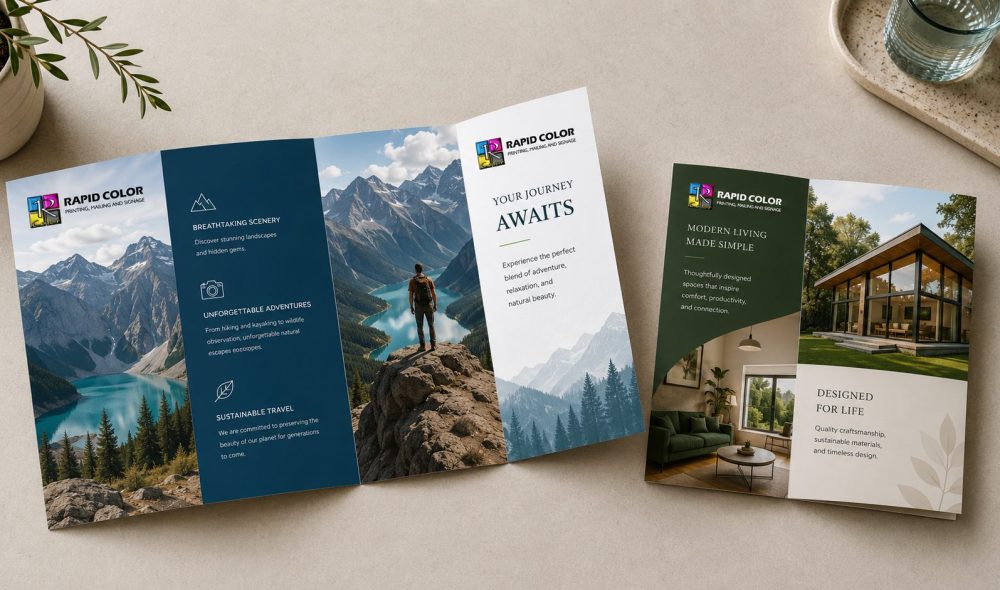
Choosing the right fold can make or break your marketing piece, and the tri-fold brochure remains one of the most trusted formats for businesses that want to say a lot in a compact, pocket-friendly package. But it is not the only option on the table. The bi-fold brochure offers a cleaner, more open layout that some brands prefer for premium presentations. If you have ever stood at the printer trying to decide between the two, you are not alone. This guide breaks down both formats side by side so you can pick the winner for your goals. For professional brochure printing in Las Vegas, Rapid Color helps you match format, paper, and finish to your message.
Brochures are still one of the highest-impact pieces of printed marketing collateral a business can hand to a prospect. Unlike a digital ad that vanishes with a scroll, a folded brochure lingers on a desk, a fridge, or a counter, reminding the reader of your brand for days or weeks. The format you choose controls how that reminder feels organized and informative, or open and premium. Getting the fold right is the first and most important creative decision you will make.
What Is a Tri-Fold Brochure?
A tri-fold brochure takes a single flat sheet and folds it twice to create six panels – three on the front and three on the back. The most common version uses a letter-fold, where the right panel folds in first and the left panel wraps over it. When closed, a standard tri-fold brochure fits neatly into a #10 envelope or a display rack, which is exactly why it dominates lobbies, trade show tables, and direct mail campaigns.
The format gives you six distinct surfaces to organize information. Marketers love this structure because it naturally guides the reader through a sequence: a cover panel to grab attention, inner panels to build the story, and a back panel for contact details or a call to action. A well-planned tri-fold brochure feels less like a flyer and more like a mini-presentation that unfolds in stages.
Common Tri-Fold Variations
- Letter fold: the classic six-panel layout used for most service menus and company overviews.
- Z-fold: panels fold like an accordion, ideal when you want each panel revealed in a straight zig-zag rather than nested.
- Roll fold: panels roll inward, useful for longer narratives where information builds progressively.
What Is a Bi-Fold Brochure?
A bi-fold folds a single sheet once down the middle, creating four panels – two on the front and two on the back. Think of it like a greeting card or a restaurant menu. The format is simple, elegant, and gives you larger uninterrupted panels to work with. When a brand wants room for big photography, generous white space, or a feature spread, the bi-fold delivers a more open canvas than its three-panel cousin.
Because there are fewer panels, the bi-fold is often the choice for upscale or visual-heavy content: real estate listings, event programs, product catalogs, and portfolio pieces. The larger panel size lets a single hero image or headline breathe, which can feel more premium than a densely packed grid of small panels. Where the goal is impact over information volume, the bi-fold format earns its place.
Tri-Fold vs Bi-Fold: Side-by-Side Comparison
The quickest way to decide is to compare the two formats across the factors that matter most for your campaign.
| Factor | Tri-Fold Brochure | Bi-Fold Brochure |
| Panels | 6 (three per side) | 4 (two per side) |
| Best for | Service menus, mailers, racks | Photo features, menus, programs |
| Content density | High – organized in sections | Low to medium – spacious |
| Folded size | Compact, fits #10 envelope | Larger half-sheet panels |
| Feel | Informational, structured | Premium, editorial |
| Typical cost | Comparable per piece | Comparable per piece |
When the Tri-Fold Brochure Wins
If your goal is to communicate several points of information in a portable format, the tri-fold brochure is hard to beat. The six-panel structure lets you separate features, benefits, pricing, and contact details into digestible chunks. A tri-fold brochure is the workhorse of small business marketing for a reason – it organizes a lot of content without overwhelming the reader.
Ideal Tri-Fold Use Cases
- Direct mail campaigns where the piece needs to fit a standard envelope.
- Display racks at hotels, visitor centers, and waiting rooms along the Las Vegas Strip.
- Service-based businesses listing multiple offerings such as salons, clinics, and contractors.
- Trade show handouts that travelers can tuck into a bag or pocket.
Because the tri-fold brochure breaks content into a natural reading sequence, it works beautifully when you want to lead a prospect from awareness to action across consecutive panels. The inside spread reveals all four interior panels at once, giving you a wide stage for your strongest selling points.
| Ready to print a brochure that converts? Rapid Color’s Las Vegas team handles design support, folding, and premium finishes in-house. Request a free quote today and we’ll recommend the perfect format for your campaign. |
When the Bi-Fold Format Wins
The bi-fold shines when presentation matters more than panel count. With only four panels, each surface is roughly the size of half a letter sheet, so your photography and headlines command attention. If you are selling a high-value experience – a luxury property, a fine-dining menu, a gala program – the open layout signals quality before a single word is read.
Designers often reach for this format when the brand story is told visually. A single full-bleed photograph spanning the inside spread can do more persuasive work than three columns of text ever could. If your audience responds to aspiration and atmosphere rather than feature lists, the four-panel format is your ally.
Ideal Bi-Fold Use Cases
- Real estate and property feature sheets with large listing photos.
- Restaurant and catering menus that need clean, readable sections.
- Event programs, wedding itineraries, and conference agendas.
- Corporate capability statements where fewer, bolder pages feel more confident.
Design Considerations for Both Fold Types
Whichever format you choose, smart design keeps the message clear once the paper is folded. Many first-time projects fail because the design was created on a flat artboard without accounting for where the folds land. Always set up your file with the correct panel dimensions and a small allowance so text never crowds a crease.
Mind the Panel That Folds In
On a letter-fold tri-fold brochure, the right-hand panel folds inward first, so it is slightly narrower than the others – usually by about 1/16 of an inch. If you size all panels identically, the inner panel can buckle. Professional printers account for these fold types automatically, but if you supply your own artwork, build the narrow panel into your template.
Guide the Eye
Use a clear visual hierarchy: a bold cover, scannable subheads inside, and a single dominant call to action. For a tri-fold brochure, treat the cover and the first interior panel as your hook. For a bi-fold, let one strong image anchor the inside spread. Keep body copy short and let white space do some of the work.
Bleed, Margins, and Safe Zones
- Extend background colors and images 1/8 inch past the trim edge for full bleed.
- Keep critical text at least 1/4 inch away from folds and trim lines.
- Set folds as guides in your design file so panels align perfectly.
Paper Weight and Stock Recommendations
Paper is what your reader actually feels, and the right stock changes the entire impression of your piece. Too thin and the brochure feels cheap and flimsy; too thick and the folds can crack. The goal is a paper weight that folds cleanly while still feeling substantial.
| Stock | Typical Weight | Best Use |
| 100 lb gloss text | Light, smooth | High-volume tri-fold mailers |
| 80 lb matte text | Medium, premium feel | Service menus, rack cards |
| 100 lb cover | Heavy, rigid | Bi-fold feature sheets |
| 14 pt C2S | Card-like | Luxury bi-fold presentations |
For a folding piece, text-weight stocks in the 80–100 lb range usually fold without scoring. If you choose a heavy cover stock for a premium bi-fold, ask your printer to score the fold first so the surface does not crack. Coating also matters: a soft-touch or matte finish reads as upscale, while gloss makes photography pop. The right stock turns an ordinary handout into a piece people are reluctant to throw away.
Finishing Touches That Elevate Either Fold
Beyond paper, finishing is where a good brochure becomes a memorable one. Spot UV coating draws the eye to a logo or headline with a glossy contrast against a matte background. Soft-touch lamination adds a velvety feel that signals premium quality the moment someone picks it up. Foil stamping and embossing create tactile detail that flat ink cannot match. These options work on both a tri-fold brochure and a four-panel layout, so choose based on budget and brand personality rather than fold type alone.
Template and File Setup Tips
- Start from a printer-supplied template sized for your final folded dimensions.
- Build artwork in CMYK at 300 DPI so colors print true and images stay sharp.
- Export a single press-ready PDF with crops, bleed, and fold marks included.
| Not sure which paper or fold suits your project? Talk to a Rapid Color print specialist. Contact our Las Vegas studio for hands-on guidance and a free paper sample pack. |
Conclusion: Which Format Wins?
There is no single champion the winning format depends entirely on your message. Choose the tri-fold brochure when you need to organize multiple points of information into a compact, mailable, rack-friendly package; it is the most versatile choice for service businesses and direct mail. Choose the bi-fold when you want a premium, photo-forward presentation with room to breathe. Match the format to your content, pick a stock that folds cleanly, and respect the fold lines in your design, and either option will represent your brand beautifully. When you are ready to print, partner with a local team that understands fold types, stock, and finishing inside and out and your brochure printing project will do exactly what you hired it to do.
Frequently Asked Questions
What is the difference between a tri-fold and bi-fold brochure?
A tri-fold brochure folds twice into six panels, while a bi-fold folds once into four. Tri-folds suit dense information; bi-folds suit larger, photo-heavy layouts.
Which brochure format is best for direct mail?
The tri-fold brochure is usually best for direct mail because it folds compactly to fit a standard #10 envelope and organizes content into clear panels.
What paper weight should I use for a tri-fold brochure?
Most folding brochures print well on 80–100 lb text stock, which folds cleanly without cracking while still feeling professional in the reader’s hands.
Can a tri-fold brochure use heavy cardstock?
Yes, but heavy cover stock should be scored before folding to prevent cracking. For most tri-fold pieces, a text-weight stock folds more reliably.
How many words fit on a tri-fold brochure?
A typical tri-fold brochure holds roughly 350–500 words across six panels, keeping copy scannable with short headings, bullets, and supporting images.
Is a bi-fold or tri-fold more affordable to print?
Both cost about the same per piece since they use one sheet. Final price depends more on paper weight, coating, color, and total quantity ordered.
Where can I get brochures printed in Las Vegas?
Rapid Color offers full-service brochure printing in Las Vegas, including design help, multiple fold types, premium paper, and fast local turnaround.