
Paper is the only part of a printed piece your customer physically touches, and it communicates before a single word is read. A limp business card undermines an expensive brand identity. An overweight flyer wastes money nobody notices. Yet paper weight remains the specification most buyers guess at, largely because the industry describes it using two incompatible systems and a vocabulary that assumes you already know the answer. This guide translates all of it into practical choices. Anyone specifying stock for brochure printing in Las Vegas will find the fold and thickness rules below especially useful, and the same logic applies to every other format on your list.
What Does Paper Weight Actually Measure?
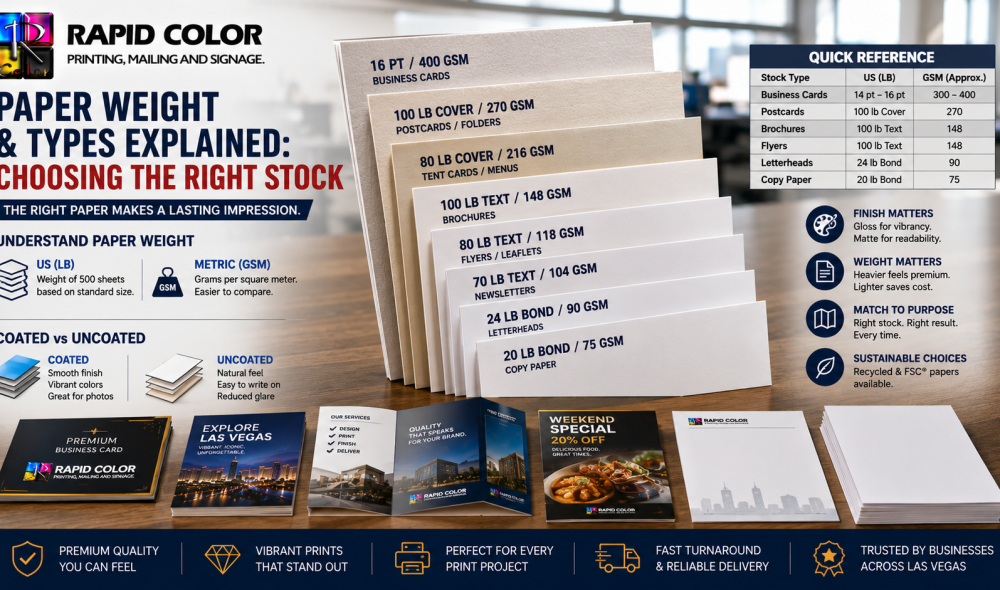
In the United States, paper weight is expressed in pounds and refers to the weight of 500 sheets cut to that grade’s basic size. The catch is that the basic size differs by grade. Text stock is measured at 25 by 38 inches, cover stock at 20 by 26 inches. That is why 80 lb cover feels dramatically thicker than 80 lb text despite carrying the same number.
The metric system avoids that confusion entirely. GSM, or grams per square meter, measures the weight of a single sheet one meter square, regardless of grade. A higher gsm number always means a heavier sheet. If the pound figures ever feel contradictory, ask for the gsm equivalent, since paper weight in gsm is directly comparable across every stock in the building.
Quick Conversion Reference
Common text weights convert roughly as follows: 70 lb text is about 104 gsm, 80 lb text about 118 gsm, and 100 lb text about 148 gsm. On the cover side, 80 lb cover is about 216 gsm, 100 lb cover about 270 gsm, and 130 lb cover about 350 gsm. Business card stock typically sits between 300 and 400 gsm.
Note that thickness and paper weight are related but not identical. Two sheets of the same gsm can differ in caliper depending on how the paper was made, which matters for folding, scoring, and feeding through a press.
Text Weight, Cover Weight, and Bond: The Three Families
Bond is the lightest family and covers everyday office paper, letterhead, and forms. Standard copier paper is 20 lb bond, roughly 75 gsm. Letterhead usually steps up to 24 lb or 28 lb bond so it feels deliberate in an envelope.
Text weight is the workhorse of commercial print. It folds cleanly, takes ink well, and covers most flyers, brochures, newsletters, and book interiors. Cover weight is heavier, stiffer, and used where a piece must stand up on its own: business cards, postcards, folders, tent cards, and booklet covers.
The practical rule is simple. If the piece will be folded and read, choose text. If it will be handled repeatedly, mailed unprotected, or needs to stand, choose cover. Most paper weight mistakes trace back to ignoring that distinction.
Coated or Uncoated? The Finish Changes Everything
Coated stock carries a clay layer that sits on the surface, holding ink on top of the sheet rather than letting it soak in. The result is sharper detail and more saturated color. Gloss coating maximizes vibrancy and suits photography. Silk and matte coatings reduce glare, which makes them easier to read under overhead lighting and considerably better for text-heavy pieces.
Uncoated stock absorbs ink, producing softer edges and slightly muted color. It also takes pen ink, which coated stock resists. Any piece someone will write on, such as a reply card, appointment card, or form, should be uncoated regardless of paper weight.
Specialty and Textured Stocks
Linen, felt, laid, and cotton stocks add tactile character and are worth considering for invitations, certificates, and premium identity pieces. They cost more, they shift color slightly because of surface irregularity, and they usually require a heavier paper weight to feel correct. Recycled and FSC-certified stocks are now available across most weights with negligible quality difference.
Which Paper Weight Should You Use for Each Piece?
Business Cards
Standard business cards run 14 pt to 16 pt, roughly 300 to 400 gsm. Anything lighter feels like a coupon. Premium cards go to 32 pt or use duplexed layers, which doubles the paper weight and creates a visible colored edge.
Flyers and Handouts
Single-sheet flyers work well at 100 lb text, about 148 gsm. That paper weight feels substantial in the hand without becoming expensive at volume, and it survives a day in a bag. For high-volume street distribution, 80 lb text keeps costs down without feeling cheap, which is why flyer printing in las vegas campaigns often run two weights side by side. Choosing the right paper weight for each audience is usually cheaper than printing everything on one stock. Most flyer printing in las vegas runs sit in exactly this band, and dropping below 80 lb text is a false economy for anything handed to a customer directly.
Brochures
Tri-fold and bi-fold brochures perform best at 80 lb to 100 lb text. Heavier stock resists folding cleanly and can crack along the fold unless it is scored first. If you want a premium feel, ask for scoring rather than jumping to cover weight, which usually solves the problem at lower cost. Most brochure printing in Las Vegas quotes include scoring as standard on heavier text stocks, so it is worth confirming.
Postcards and Direct Mail
Postcards need to survive automated postal equipment, so cover weight is not optional. Aim for 14 pt to 16 pt, around 300 to 400 gsm. Postal services also impose minimum thickness requirements for card-rate mail, so confirm the specification before printing rather than after. A thin card that jams sorting equipment can be surcharged or returned, which turns a small saving into a large delay. Postcard printing in Las Vegas for automated mail almost always defaults to 16 pt for this reason. Anyone planning postcard printing in Las Vegas for a mail campaign should verify both paper weight and finished size against current postal rules.
Menus, Booklets, and Presentation Folders
Menus need durability and wipe resistance, which usually means 100 lb cover with a matte or soft-touch laminate. Our guide to restaurant menu printing covers coating choices in more depth. Booklet interiors sit at 70 lb to 100 lb text with a cover at 80 lb to 100 lb cover. Presentation folders require 100 lb cover minimum, since anything lighter collapses once loaded.
How Paper Weight Affects Cost and Postage
Paper is typically the largest single material cost in a print job, and cost scales almost linearly with weight. Moving a 5,000-piece flyer run from 80 lb text to 100 lb text raises material cost by roughly a quarter. Whether that is worthwhile depends entirely on how the piece is used.
Mailing changes the calculation sharply. Postage is priced by weight bracket, and a heavier sheet can push an entire campaign into a higher tier, at which point paper weight affects far more than the printing invoice. Before committing to a heavier stock on a mailed piece, ask your printer to weigh a mock-up of the finished item, including any envelope and insert. Rapid Color routinely runs that check for mail campaigns because the postage difference can exceed the paper saving several times over.
Ask for Samples Before You Commit
No description substitutes for holding the sheet. Any established las vegas printing company will supply a paper sample book or produce a blank mock-up in your chosen stock. Ten minutes with samples prevents the most expensive mistake in print buying, which is discovering the paper weight is wrong after 10,000 copies have already been produced.
Frequently Asked Questions
What is the difference between lb and gsm paper weight?
Pounds measure 500 sheets at a grade’s basic size, which differs between text and cover stock. GSM measures one square meter of a single sheet, so it compares directly across every paper type and removes the confusion caused by pound figures.
What paper weight is best for business cards?
Most professional business cards use 14 pt to 16 pt stock, roughly 300 to 400 gsm. Premium options reach 32 pt or use duplexed layers, producing a noticeably thicker card with a visible colored edge along the sides of the sheet.
Should flyers be printed on coated or uncoated paper?
Coated stock suits image-heavy flyers because it holds color and detail sharply on the surface. Uncoated works better when recipients need to write on the piece, or when a natural, understated appearance suits the brand better than gloss.
What paper weight do postcards need for mailing?
Postal services require a minimum thickness for card-rate mail, so most postcards use 14 pt to 16 pt cover stock. Confirm current thickness and finished size requirements before printing, since undersized or thin cards attract surcharges or rejection.
Does heavier paper always look more professional?
Not always. Weight should match function rather than budget. Folded brochures crack on stock that is too heavy, and excess weight on a disposable handout simply raises cost. Appropriate weight reads as considered; excessive weight reads as wasteful.
Can heavy paper be folded without cracking?
Cover stock above roughly 100 lb should always be scored before folding. Scoring compresses the fibers along the fold line so the sheet bends cleanly instead of splitting, which matters most on coated stocks where cracking is highly visible.
How does paper weight affect mailing costs?
Postage is calculated in weight brackets, so a heavier sheet can push an entire mailing into a higher tier. Always weigh a complete finished mock-up, including the envelope and any inserts, before confirming the stock for a large campaign.