
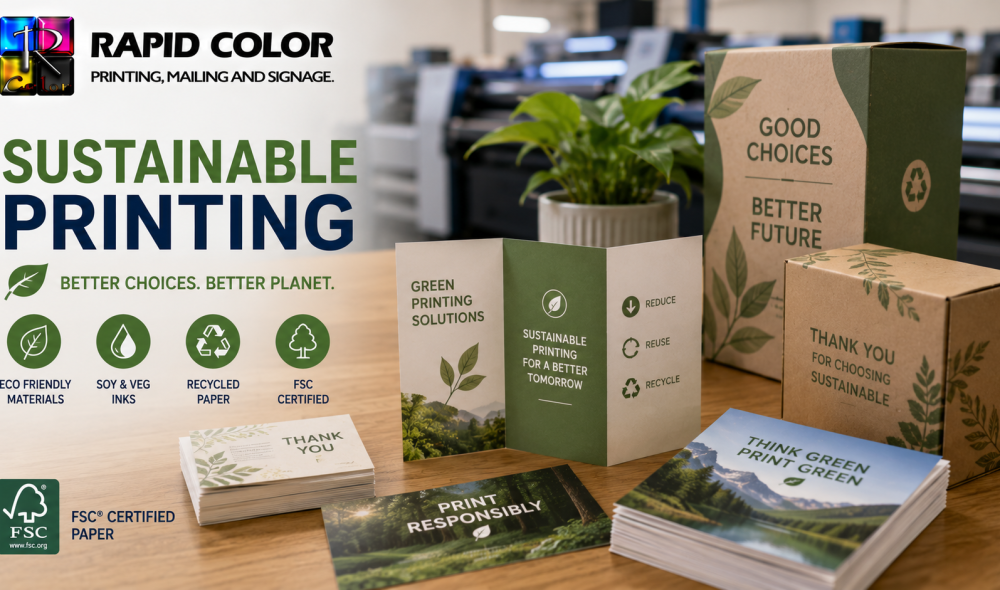
The assumption that environmentally responsible print means gray, fibrous paper and washed-out color is roughly fifteen years out of date. Recycled stocks now run brighter, vegetable-based inks reach the same density as petroleum formulations, and certified supply chains cover most commercial grades. Sustainable printing today is less about accepting compromise and more about knowing which specifications to ask for. This guide covers the choices that produce measurable environmental improvement without changing how the finished piece looks or performs. Brands rebuilding their materials often start with packaging, where a packaging printing company in las vegas can substitute substrates with no visible difference on shelf.
What Makes a Print Job Actually Sustainable?
Four variables carry almost all of the environmental impact of a printed piece, and sustainable printing is really the management of those four: the paper it is printed on, the ink used, the energy consumed in production, and how much of it is wasted. Everything else, including recycling logos and green messaging, is downstream of those four.
Paper dominates. Depending on the analysis, fiber accounts for somewhere between sixty and eighty percent of the total footprint of a typical print job. That means genuine sustainable printing decisions are mostly paper decisions, and a supplier who wants to discuss certifications before discussing stock is usually selling reassurance rather than improvement.
Waste Is the Variable Nobody Budgets For
The most environmentally damaging print run is the one that gets thrown away unread. Ordering 20,000 brochures to secure a lower unit price, then discarding 12,000 when the pricing changes, wastes more resource than any ink choice can recover. Right-sizing quantities is the least discussed and most effective sustainable printing decision available to most businesses.
Paper: Certifications, Recycled Content, and Weight
FSC and Chain-of-Custody Certification
Certification is the entry point to any sustainable printing program. Forest Stewardship Council certification confirms that fiber originates from responsibly managed forests and can be traced through every stage of the supply chain. PEFC and SFI operate comparable schemes. Crucially, certification applies to the printer as well as the mill; a printer without chain-of-custody certification cannot legitimately apply the logo to your job even when the paper itself is certified.
Ask any prospective supplier for their certification number and check it against the public register rather than accepting a logo on a website. Rapid Color holds FSC certification alongside G7 color qualification, which means a job can carry the mark legitimately rather than by implication.
Recycled Content and What the Percentages Mean
Post-consumer recycled content is the figure that matters in sustainable printing, because it represents fiber diverted from waste rather than mill offcuts that would have been reused regardless. Stocks are commonly available at thirty, fifty, and one hundred percent post-consumer waste. Print quality at thirty percent is indistinguishable from virgin stock in ordinary commercial use; at one hundred percent the sheet runs slightly warmer in tone, which suits some brands and not others. Ask for printed samples on both before standardizing, because the difference is easier to judge in the hand than in a specification sheet.
The pragmatic sustainable printing approach is to specify thirty to fifty percent post-consumer content as a default across all standard work, then reserve virgin stock for the small number of pieces where an exceptionally bright white is essential.
Weight Reduction as an Environmental Choice
Dropping a brochure from 100 lb text to 80 lb text reduces fiber use by roughly twenty percent and lowers shipping and postage weight at the same time. On a large mailing, that single change delivers more environmental benefit than switching ink type, and it reduces cost rather than adding it. Weight reduction is the rare sustainable printing decision with no trade-off attached.
Inks, Coatings, and Finishing
Ink is the second lever in sustainable printing, though a smaller one than paper. Soy and vegetable-based inks have largely replaced petroleum inks for offset work. They come from renewable sources, release far fewer volatile organic compounds, and de-ink more cleanly during recycling, which improves the recovered fiber. Color density and drying performance are now equivalent for standard commercial work.
Coatings deserve closer scrutiny than inks, because they decide whether a finished piece can be recycled at all. Aqueous coating is water-based and does not impede recycling. UV coating is more durable but complicates the process. Plastic lamination is the significant problem: a laminated sheet is effectively a composite material and is rejected by most recycling streams. If a piece must be laminated for durability, biodegradable or compostable films are now available, though they cost more.
Finishes Worth Reconsidering
Metallic foils, plastic windows in envelopes, and spot UV over large areas all reduce recyclability. None of them is forbidden in a sustainable printing program, but each should be a deliberate choice rather than a default, applied where it earns its impact rather than across every piece in a range.
Packaging: Where the Biggest Gains Are Available
Packaging is where sustainable printing produces the most visible results, because customers physically handle the outcome. Corrugated board is already among the most recycled materials in circulation, with recovery rates well above most plastics, so specifying corrugate over plastic mailers is an immediate and measurable improvement.
Any experienced packaging printing company in las vegas will raise this before discussing artwork. Beyond material choice, structure matters enormously. Right-sizing a box reduces board consumption, cuts void fill, and lowers shipping emissions by improving pallet density. Many brands ship air, paying freight on empty space in every carton. A box printing in las vegas supplier can usually redesign a carton around the actual product dimensions and reduce material by a fifth without any change in protection.
Water-based flexographic printing on kraft board avoids bleaching entirely and produces the unbleached aesthetic many brands now prefer, and most box printing in las vegas suppliers stock it as standard. Our guide to custom packaging for small business covers low-minimum options for companies testing these formats before committing to volume.
How Does Sustainable Printing Affect Direct Mail?
Mail attracts more environmental criticism than any other print category, and sustainable printing has a clear answer for most of it. The response is not to abandon the channel but to target it properly. A precisely targeted direct mail printing in las vegas campaign of 5,000 pieces with a three percent response rate consumes far less material than an untargeted run of 25,000 at half a percent, and it performs better commercially.
Three specifications do most of the work here. Specify recycled stock, choose paper-based windows or windowless designs for envelopes, and avoid plastic polywrap on multi-piece mailings. Reducing sheet weight lowers both postage and material use simultaneously. Applied together, these adjustments make direct mail printing in las vegas campaigns measurably lighter without reducing reach or response.
Claims You Can Actually Make
Be precise in what you print about your own practices. “Printed on FSC-certified 50% post-consumer recycled stock with vegetable-based inks” is verifiable and defensible. Vague phrases such as “eco-friendly” invite scrutiny and, in some jurisdictions, regulatory attention. Sustainable printing claims should always be traceable to a certification number or a specification line on the invoice.
Building a Practical Program
A sustainable printing program does not need to begin with a policy document. Start by auditing existing work. Identify the three highest-volume items in your annual print spend, since improving those delivers more than optimizing every low-volume piece. Set a default sustainable printing specification covering recycled content, ink type, and coating policy, then apply it automatically to all new work unless a piece justifies an exception.
Then review quantities honestly against actual consumption over the previous two years. Most organizations discover that a sustainable printing program pays for itself through waste reduction alone, before any premium for certified stock is considered.
Frequently Asked Questions
What is sustainable printing?
Sustainable printing is the practice of reducing the environmental impact of printed material through certified or recycled paper, vegetable-based inks, recyclable coatings, energy-efficient production, and accurate quantities that limit waste.
Does recycled paper reduce print quality?
Not at typical levels. Stocks with thirty to fifty percent post-consumer content are visually indistinguishable from virgin paper in commercial use. Fully recycled sheets run slightly warmer in tone, which suits many brands rather than harming them.
Are soy inks as good as conventional inks?
Yes for standard commercial work. Vegetable and soy inks match petroleum inks on color density, release far fewer volatile compounds, and separate more cleanly during recycling, which improves the quality of recovered paper fiber.
Is sustainable printing more expensive?
Certified and recycled stocks often carry a small premium, typically under ten percent. That difference is frequently offset by reducing paper weight and ordering more accurate quantities, so total spend often stays flat or falls.
Can laminated print be recycled?
Plastic-laminated sheets are rejected by most recycling streams because they combine paper and film. Use aqueous coating where durability allows, or specify compostable laminate films when a protective surface is genuinely required.
What certifications should I look for?
FSC is the most widely recognized standard, with PEFC and SFI as equivalents. Confirm your printer holds chain-of-custody certification, not just the mill, since only a certified printer can legitimately apply the logo.
How can direct mail be made more sustainable?
Target tightly to reduce volume, specify recycled stock, lower sheet weight, avoid plastic polywrap, and use paper windows or windowless envelopes. Better targeting reduces material use and improves response rates at the same time.