
Introduction
Booklet printing las vegas projects fail on page count more often than on artwork. A designer builds a 22 page programme, sends it to press, and finds out that saddle stitching only works in multiples of four. A marketing team specs a 96 page catalogue on 100 lb gloss text and discovers the spine is too thick to fold. Both problems are solved in an afternoon at the planning stage and expensive to solve later. A full service printing operation will raise them before the file is imposed, but knowing the rules yourself makes the conversation faster and the quote more accurate.
How Booklet Printing Las Vegas Jobs Are Built
Every booklet printing las vegas job starts with one production fact: a booklet is printed as signatures, not pages. Sheets are printed on both sides, folded, gathered and trimmed, so the page count is always a multiple of the pages that fit on one folded sheet.
In booklet printing las vegas work, saddle stitched booklets fold in half, which puts four pages on every sheet. That is why saddle stitch page counts run 8, 12, 16, 20, 24 and upward in fours. Perfect bound and wire-o booklets bind individual leaves, so they move in multiples of two.
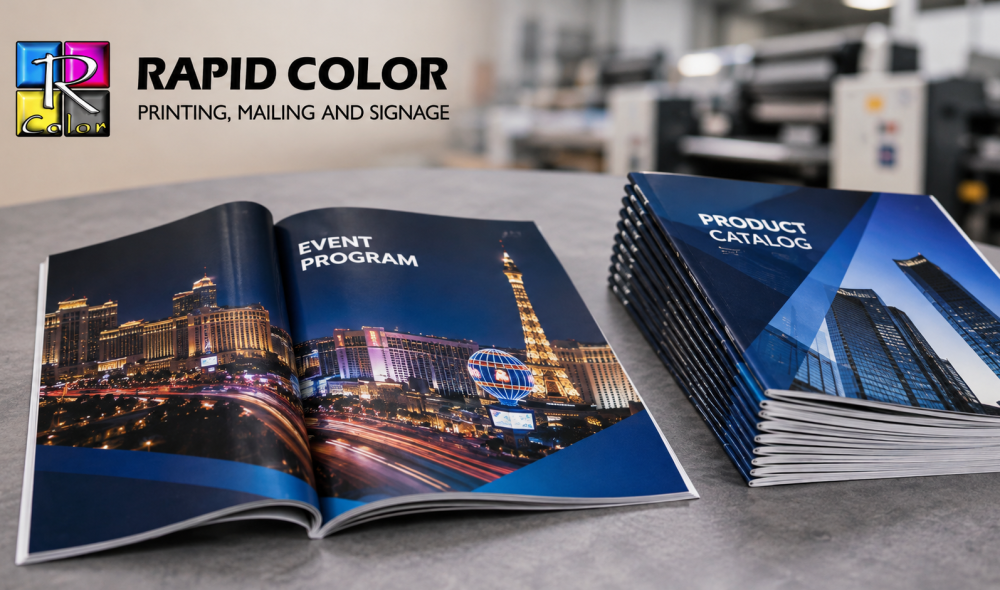
Most booklet printing las vegas projects fall into one of three families: event programmes and show guides, product catalogues, and training or reference manuals. Each family tends toward a different binding method, and knowing which family your piece belongs to shortens the specification conversation considerably.
Cover pages count in every booklet printing las vegas quote. A 16 page booklet means 16 total pages including the front cover, inside front, inside back and back cover. Designers who count only the interior are the most common source of late page count changes.
Creep and why outside margins move
On a thick booklet printing las vegas job, the inner pages push outward as the sheets nest, so the trim cuts more off the inner pages than the outer ones. This is called creep or push out. On a 48 page booklet in 80 lb text, creep can shift content by an eighth of an inch. Prepress compensates by shifting pages inward during imposition, which is another reason to keep live text well inside the trim.
How Many Pages Before You Should Switch Binding Methods?
Switch a booklet printing las vegas job from saddle stitch to perfect binding somewhere between 64 and 92 pages, depending on paper weight. That range is not arbitrary. It is the point where the folded spine stops holding a clean crease and starts bulging.
Follow the decision path for your own booklet printing las vegas project. If your booklet runs 8 to 48 pages on 80 lb or 100 lb text, saddle stitch is the right answer and the cheapest one. If it runs 48 to 64 pages, saddle stitch still works but ask for a dummy on the actual stock, because a heavy coated sheet at 64 pages already fights the folder. If it runs 64 to 88 pages, the paper weight decides: lighter text stock can still stitch, coated 100 lb cannot. Above 88 pages, move to perfect binding and stop negotiating with the folder.
Catalog printing las vegas jobs sit at the top of that range often enough that page count should be settled before layout begins.
Perfect binding has a floor in booklet printing las vegas work as well. Below about 40 pages, the spine is too thin to take adhesive reliably and to carry legible spine type. Between 40 and 64 pages you can bind either way, and the choice becomes about how the piece should feel rather than what the equipment allows.
Wire-o and spiral binding, offered by most binding services las vegas shops, ignore both limits. They handle 20 pages or 300, and they lie flat, which is why they win for manuals, training material and anything used while someone works with their hands.
Choosing Between the Three Methods
Saddle stitch is the fastest and most economical booklet printing las vegas method, and it lies reasonably flat. It suits event programmes, short catalogues, newsletters and price lists. It has no printable spine.
Perfect binding gives a booklet printing las vegas job a square spine you can print on, which matters when the piece will sit on a shelf. It needs adhesive cure time before final trim, so it adds a day or more to production. It does not lie flat, and heavy gutter content will disappear into the spine unless the layout allows for it.
Wire-o lies completely flat and turns 360 degrees, which is why binding services las vegas shops recommend it for anything used hands on. It costs more per unit than saddle stitch and does not stack neatly, but for a workbook or wall reference it is the only sensible answer. Comb and coil binding sit in the same family with different durability and cost profiles, and any shop offering binding services las vegas clients rely on will carry all three.
The practical test in booklet printing las vegas is how the piece gets used. If someone holds it while doing something else, it needs to lie flat. If it sits on a shelf between uses, it needs a printable spine. If it is read once and recycled, saddle stitch is enough.
Paper weight and spine width
Spine width on a perfect bound booklet printing las vegas job is calculated from page count and paper caliper, not from weight alone. As a working figure, 100 pages of 80 lb text produces roughly a quarter inch spine. Coated stock is thinner per pound than uncoated, so an uncoated book of the same page count runs thicker. Your printer will calculate the figure and supply a cover template with the correct spine measurement. Cover artwork should never be built before that number exists.
Paper and Cover Decisions
Paper choice on booklet printing las vegas work is a durability decision as much as a cost one. Interior stock for most booklets sits between 70 lb and 100 lb text. Below 70 lb, heavy ink coverage shows through from the reverse side. Above 100 lb text, saddle stitched page counts get restricted quickly.
Covers on booklet printing las vegas work usually run 80 lb to 120 lb cover, often with a coating. Gloss lamination resists fingerprints and scuffing, matte lamination reads more premium and photographs better, and soft touch lamination is worth the premium only on pieces meant to be handled repeatedly.
Self covers, where a booklet printing las vegas piece uses the same stock throughout, save money and suit short newsletters and price lists. They do not survive a convention floor. Anything going into a tote bag should have a laminated cover at minimum, and additional binding and finishing such as foil stamping or embossing works only on cover weights, not text weights.
Quantity, Press Choice and Cost
Quantity decides the press on any booklet printing las vegas order. Under roughly 500 booklets, digital production is almost always cheaper and faster because there are no plates to make. Above that, offset printing runs start to win, and the gap widens with every thousand.
Catalog printing las vegas work often sits at the high end, where the page count multiplies the saving. At 5,000 copies of a 64 page catalogue, the gap between digital and offset unit cost can fund a paper upgrade. The considerations behind when offset printing makes sense apply directly to booklets, because every page is another impression.
Reprint frequency matters in booklet printing las vegas budgets too. If a catalogue updates quarterly, digital short runs keep content current and avoid obsolete inventory. If it updates annually, print the year in one offset run.
This is where catalog printing las vegas budgets are usually won or lost. Printing 10,000 copies of a catalogue that goes out of date in four months costs more than printing 2,500 copies three times, once obsolete stock is written off.
Planning Your Next Booklet
Booklet printing las vegas projects run smoothly when the specification is settled first. Start with three numbers before you start designing: final page count including covers, quantity, and the date it must be in hand. Those three decide the binding method, the press and the schedule, and everything else follows.
Send the page count to your booklet printing las vegas supplier before layout begins and ask for a spine width and a bleed template. Rapid Color and any other production shop can supply both in a phone call, and a template built to real measurements prevents the two most common booklet reprints: a cover that does not wrap and gutter content swallowed by the spine.
Frequently Asked Questions
What page counts work for saddle stitched booklets?
Saddle stitch requires multiples of four, counting covers. That means 8, 12, 16, 20, 24 and so on. If your content lands on 22 pages, add two or cut two. Most shops cap saddle stitch near 64 to 88 pages depending on stock.
How thick is a perfect bound spine?
Spine width depends on page count and paper caliper. As a rough guide, 100 pages of 80 lb text gives about a quarter inch. Uncoated stock runs thicker than coated at the same weight. Always request a calculated template before designing the cover.
Which binding method lies flat?
Wire-o, spiral and comb binding lie completely flat and rotate a full turn. Saddle stitch lies reasonably flat at low page counts. Perfect binding does not, so keep important content out of the gutter on bound catalogues and manuals.
How long does booklet printing las vegas work take?
Most booklet printing las vegas jobs run digitally in two to four business days after proof approval. Offset runs need five to seven. Perfect binding adds cure time before trimming, and large quantities add gathering and stitching time on the bindery line.
Do covers count in the page count?
Yes. A 16 page booklet includes the front cover, inside front, inside back and back cover. Counting only interior pages is the most frequent cause of imposition changes and last minute page additions.
Can I mix paper stocks in one booklet?
Yes. A heavier cover with lighter interior text is standard. You can also insert a different stock as a section divider, though it adds a bindery step and cost. Mixed stocks are simpler on wire-o than on saddle stitch.
What resolution do booklet printing las vegas images need?
Place raster images at 300 ppi at final size, and supply line art at 1,200 ppi. Build the file with 0.125 inch bleed and keep live text at least 0.25 inch from trim, more on the gutter side of bound work.