
What are the best durable print substrates for digital printing? The answer depends on where the finished piece will be used, how long it needs to perform, and what environmental conditions it will face. Synthetic papers, rigid boards, vinyl, protective coatings, and laminates can all improve print durability when matched correctly to the application. Rapid Color helps Las Vegas businesses select materials based on exposure, handling, installation, and appearance requirements. For projects that require commercial digital production, digital printing provides a flexible starting point for evaluating substrates, finishes, and production requirements.
In Las Vegas, material selection matters because printed graphics can face intense sunlight, heat, dust, and significant temperature changes. A substrate that works well for an indoor handout may not be appropriate for a storefront graphic or outdoor sign. Understanding durable print substrates helps businesses avoid choosing a material based only on appearance or initial price.
Table of Contents
- What Makes a Print Durable
- What Are the Best Durable Print Substrates
- Synthetic and Tear Resistant Papers
- Rigid Boards and Vinyl
- Coatings and Laminates That Protect
- Durability in the Las Vegas Climate
- Matching Material to Use
- Durability FAQs
What Makes a Print Durable
A durable print needs more than ink that looks sharp immediately after production. Its performance depends on the interaction between the printed image, substrate, finishing method, installation environment, and expected handling. Durable print substrates are selected to resist specific forms of wear rather than simply being labeled as heavy duty.
Moisture, abrasion, ultraviolet exposure, bending, repeated handling, temperature changes, and cleaning can all affect a printed product. A menu handled hundreds of times requires a different construction from a parking sign exposed to direct sunlight.
Digital printing can produce excellent results across a wide range of materials, but the substrate must be compatible with the printing system. Surface treatment, ink adhesion, curing, and finishing all influence the final result.
A practical production review considers whether the piece will remain indoors, move between locations, or stay outside continuously. Durable print substrates should be chosen according to the actual environment rather than based solely on thickness.
Another consideration is the expected service life. A temporary promotional sign may only need to look good for several weeks. A permanent graphic may need protection against years of exposure. The longer the expected life, the more important substrate and protective-finish selection becomes.
What Are the Best Durable Print Substrates?
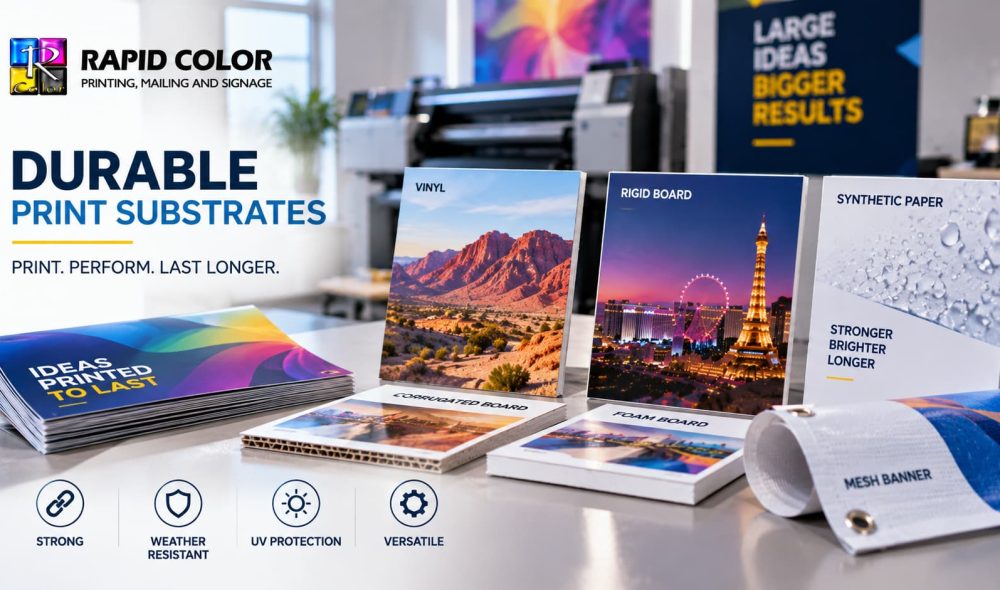
The term durable print substrates covers a broad range of materials. There is no single material that performs best for every application. Synthetic paper can provide water and tear resistance, rigid boards provide dimensional stability, and vinyl offers flexibility for curved or irregular surfaces.
The correct choice also depends on whether the finished product needs to be rolled, folded, mounted, cut, drilled, transported, or installed permanently.
| Material | Main Strength | Common Uses | Durability Consideration |
| Synthetic paper | Tear and moisture resistance | Menus, maps, tags | Good for frequent handling |
| PVC or rigid board | Structural stability | Signs, panels, displays | Good for rigid applications |
| Vinyl | Flexible and versatile | Wall graphics, decals, vehicle graphics | Choose outdoor grade when required |
| Laminated print | Surface protection | Signs, graphics, displays | Helps resist abrasion and moisture |
| Coated paper | Improved surface protection | Marketing materials | Better suited to controlled environments |
When comparing durable print substrates, it is important to separate physical strength from environmental resistance. A rigid board can resist bending but still require protection from prolonged sunlight. Similarly, a flexible vinyl graphic may handle movement well but need a protective laminate for demanding outdoor use.
Synthetic and Tear Resistant Papers
Synthetic paper is useful when a printed product needs to withstand moisture, repeated handling, or tearing better than conventional paper. These materials are often used for menus, maps, instructional sheets, tags, reference cards, and other applications where paper-like handling is desirable without traditional paper’s vulnerability.
The value of synthetic media is that it can combine a familiar printed appearance with improved resistance to water and tearing. It is especially useful where the material will be handled frequently or exposed to occasional moisture.
For durable print substrates, synthetic media can provide a useful middle ground between ordinary paper and heavier rigid materials. The final selection still depends on the printer’s equipment, ink system, required finish, and intended use.
A common mistake is assuming that synthetic paper automatically makes a print suitable for permanent outdoor exposure. Outdoor durability depends on the complete construction, including the ink system and any protective coating or laminate.
Rigid Boards and Vinyl
Rigid boards provide dimensional stability for signs, displays, mounted graphics, retail panels, and other applications where the finished piece needs to remain flat. Different board constructions offer different combinations of weight, rigidity, surface quality, and finishing options.
Vinyl is more flexible and can conform to walls, windows, vehicles, displays, and other curved or irregular surfaces. Depending on the application, vinyl may be used for temporary indoor graphics or more demanding outdoor signage.
For durable print substrates, vinyl selection should consider adhesive requirements, exposure length, surface type, temperature, and whether removal is expected. A material intended for an indoor wall should not automatically be specified for continuous exterior exposure.
Large graphics require additional planning because installation conditions can affect their service life. For projects involving oversized graphics and signage, Rapid Color’s large format printing Las Vegas service can help evaluate the appropriate material and finishing approach.
Tear Resistant Printing for Demanding Applications
Tear resistant printing is useful when printed materials need to withstand frequent handling, transportation, or repeated use. Synthetic materials can provide added strength compared with standard paper, making them suitable for menus, instructional sheets, tags, maps, event materials, and promotional pieces that are handled often. The right substrate can also help maintain a clean appearance when the printed piece is exposed to moisture or rough conditions.
For businesses that need long lasting prints, material selection should be considered alongside ink, finishing, and the intended environment. A durable substrate may perform better when paired with protective coatings or lamination. Indoor displays, retail graphics, outdoor signs, and frequently handled promotional materials can all require different specifications. Choosing the right combination helps maintain readability, appearance, and structural integrity throughout the expected service life. Rapid Color can help businesses select materials based on application, exposure, handling, and desired durability.
Coatings and Laminates That Protect
Protective coatings and laminates can add another layer of defense between a printed image and the surrounding environment. They can help reduce surface abrasion, moisture exposure, scratches, and other forms of everyday wear.
A laminate is particularly useful when the graphic will be touched frequently or cleaned regularly. For example, a printed sign in a busy retail environment may benefit from protection that a low-touch indoor poster does not need.
Gloss, matte, and other surface finishes can also change the visual character of the printed piece. A glossy laminate can enhance color and contrast, while a matte finish can reduce reflections and provide a softer appearance.
When selecting durable print substrates, the laminate should be considered part of the finished construction rather than an afterthought. A substrate, ink system, adhesive, and laminate need to work together.
UV exposure is another consideration. Ultraviolet radiation can contribute to fading over time. NOAA explains that UV radiation reaching the Earth’s surface varies according to factors including solar position, ozone, clouds, aerosols, and elevation. This makes UV exposure an important consideration when specifying durable print substrates for outdoor applications.
A protective finish does not make every graphic permanently fade proof. Expected life should always be discussed in relation to exposure, location, material construction, and maintenance.
Durability in the Las Vegas Climate
Las Vegas presents specific environmental challenges for printed graphics. Strong sunlight, high summer temperatures, dry conditions, dust, and repeated temperature changes can place more stress on materials than a controlled indoor environment.
For outdoor graphics, UV resistance becomes particularly important. Durable print substrates selected for exterior use should be evaluated for the expected exposure period and the type of installation. A temporary event graphic has different requirements from a permanent storefront sign.
Heat can also affect adhesives and flexible materials. When a graphic is installed on a surface that becomes extremely hot in direct sunlight, the substrate and adhesive need to be appropriate for those conditions.
Dust and cleaning are additional considerations. A graphic installed near a busy road or outdoor retail area may accumulate dirt and require periodic cleaning. A protective finish can make maintenance easier, but cleaning methods should be compatible with the material.
The Las Vegas climate therefore makes durable print substrates especially useful for applications where graphics must maintain their appearance despite environmental exposure. Material selection should start with the location and expected service life, then move to appearance and budget.
UV exposure is an important consideration for outdoor printed materials because prolonged sunlight can contribute to fading and material degradation. According to NOAA’s UV Index information, UV radiation reaching the surface is influenced by factors such as solar elevation, ozone, clouds, elevation, and atmospheric conditions. For outdoor signage and graphics, selecting UV resistant inks, suitable substrates, and protective finishes can help improve long term performance.
Matching Material to Use
The best material is determined by the job rather than by a generic ranking of substrates. An indoor directional sign may need a rigid board with a clean surface. A frequently handled menu may benefit from synthetic paper. A wall graphic may require flexible vinyl, while an exterior sign may require a combination of an appropriate substrate, outdoor-rated ink, and protective finish.
For durable print substrates, the first question should be where the finished product will live. The second is how it will be handled. The third is how long it needs to remain functional and visually acceptable.
A simple material selection process can compare these factors:
| Application | Recommended Direction | Main Concern |
| Indoor poster | Coated paper or board | Appearance |
| Frequently handled menu | Synthetic paper | Moisture and tearing |
| Retail wall graphic | Vinyl | Adhesion and surface |
| Outdoor sign | Rigid board or outdoor vinyl | UV and weather |
| Long term display | Protected substrate | Fading and abrasion |
| Temporary event graphic | Vinyl or lightweight board | Transport and setup |
Cost should also be evaluated over the expected life of the product. A less expensive material that needs frequent replacement may cost more over time than a stronger construction that lasts longer.
For durable print substrates, Rapid Color can review the intended application, finished size, installation environment, and expected service life before production. This approach helps avoid over specifying a material for a short term project or under specifying one that must survive years of exposure.
The printing process itself also matters. Digital equipment varies in its compatibility with different media, and not every substrate is suitable for every press. The correct combination of equipment, ink, substrate, and finishing produces a more reliable result.
Durability FAQs
What Are Durable Print Substrates?
Durable print substrates are printing materials selected to withstand specific forms of physical or environmental stress. Examples include synthetic papers, rigid boards, vinyl, and specialty media designed for moisture, abrasion, handling, or outdoor exposure.
What Is the Best Material for Outdoor Printing?
The best material depends on the application. Outdoor vinyl and rigid boards are common choices, but the correct option depends on exposure, installation surface, expected service life, and required flexibility.
Is Synthetic Paper Waterproof?
Many synthetic papers offer strong resistance to water and moisture, but performance varies by product and printing system. For demanding applications, the complete printed construction should be evaluated rather than assuming all synthetic papers perform identically.
Does Lamination Make Digital Printing More Durable?
Lamination can improve resistance to scratches, moisture, abrasion, and handling. It can also change the surface appearance. However, it does not automatically make every printed product suitable for permanent outdoor exposure.
What Makes a Print UV Resistant?
UV resistance depends on the substrate, ink or toner technology, protective coating, laminate, and exposure conditions. Durable print substrates intended for outdoor use should be selected with the expected sunlight exposure in mind.
Are Vinyl Prints Good for Outdoor Use?
Outdoor rated vinyl can be a strong choice for many exterior graphics. The appropriate vinyl grade, adhesive, ink system, and protective finish depend on the surface and expected exposure.
How Long Do Durable Prints Last?
There is no universal lifespan. Durable print substrates can last from weeks to years depending on the material, printing system, finishing, exposure, installation, and maintenance.
Are Rigid Boards Better Than Vinyl?
Neither is universally better. Rigid boards are useful when structural stability is important, while vinyl is useful when flexibility or adhesion to irregular surfaces is required. Durable print substrates should be matched to the physical requirements of the application.
Can Digital Printing Be Used for Outdoor Graphics?
Yes. Digital printing can be used for outdoor graphics when the printer selects an appropriate substrate, ink system, and protective finish. The expected exposure period should be established before production.
How Do I Choose Durable Materials for a Las Vegas Project?
Consider the location, exposure, handling, installation method, lifespan, and budget. Durable print substrates should match the project’s environment rather than simply being the heaviest or most expensive option.
For help choosing the right material for your project, call Rapid Color at 702-792-6055.