
Introduction
Most branded giveaways are discarded within a week. Calendars and notepads are the exceptions, because they earn their place by being useful every day for a year. A wall calendar in a break room is seen by everyone in the room, several times a day, for twelve months. A branded notepad sits under a customer’s hand while they take notes about someone else’s business. That kind of persistent visibility is difficult to buy any other way, which is why calendar printing las vegas orders remain a fixture of year end marketing budgets. Choosing the right format and ordering into the right printing services production window is what determines whether they arrive in time to matter.
Calendar Printing Las Vegas Formats and Who They Suit
Format should be chosen by where the calendar will physically live, because that decides how much branding is visible and for how long. Calendar printing las vegas orders usually settle into four formats.
Wall formats, the most requested calendar printing las vegas option at 11 x 17 folded or 12 x 12 square, give the largest image area and the longest viewing distance. They suit trades, logistics, medical offices and anywhere a shared team space exists. Twelve image panels plus a cover give thirteen printed surfaces of brand presence.
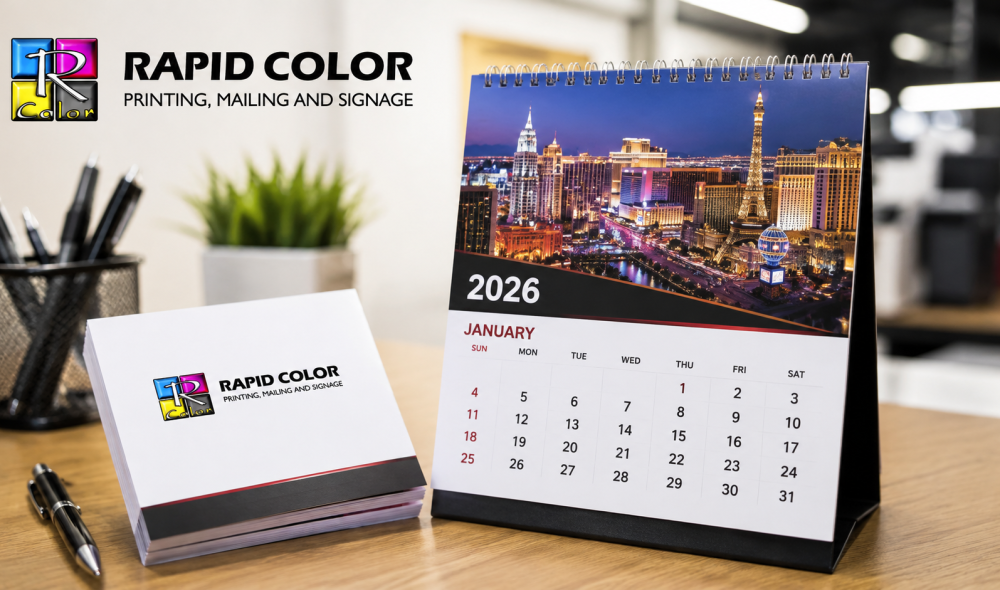
Desk calendar printing las vegas formats sit within arm’s reach and are read at close range, so they carry more detailed information. Tent style desk calendars stand on an easel fold and suit reception desks and workstations. Flat desk pad calendars, often 17 x 22 or 22 x 17, double as a writing surface and are among the longest lived items in this category.
Magnetic calendar printing las vegas formats hold a refrigerator or a filing cabinet and cost less than any bound format. They suit real estate, home services, restaurants and anyone whose customer contacts them from home.
Pocket and card formats are the cheapest calendar printing las vegas option per unit and useful as a mailing insert or a counter takeaway rather than a primary piece.
Notepad formats
Notepad printing las vegas orders usually run in three sizes: 4 x 6 for counter and giveaway use, 5.5 x 8.5 as the standard branded pad, and 8.5 x 11 for full page use in meetings and on desks. Sheet counts of 25, 50 and 100 are standard, with 50 the most common balance of cost and longevity.
Because notepad printing las vegas jobs carry no dated content, they are often used to fill press capacity in quieter weeks, which is worth asking about when timing is flexible.
Binding, Padding and Construction
Construction determines both cost and how the piece behaves in use. Calendar printing las vegas orders are bound differently depending on where they hang.
Wire-o binding is the calendar printing las vegas standard for wall formats. It lies flat, turns a full 360 degrees, and takes a hanging hook cleanly. Saddle stitching works for calendar booklets that hang from a single point but does not turn as cleanly.
Tent calendar printing las vegas formats are usually scored, folded and either wire bound along the top or assembled with a fold and glue construction that forms the easel.
Notepads are padded rather than bound. Sheets are stacked, jogged square, and the top edge is coated with padding compound that flexes and releases one sheet at a time. A chipboard backing gives the pad rigidity, and the standard weight is a heavy board that survives being carried in a bag.
Additional binding and padding options extend the piece further. Foil stamping on a calendar cover, embossing a logo on a notepad backer, or drilling a hanging hole are small production steps that noticeably change how the piece is perceived.
Paper and Print Specification
Calendar printing las vegas specifications start with interior stock, which usually runs 70 lb to 100 lb text. Below that, ink shows through from the panel behind. Coated gloss suits image heavy calendars, while uncoated or matte stock is easier to write on, which matters if the calendar will be used for scheduling rather than decoration.
Calendar printing las vegas covers typically use 100 lb cover, often with a laminate on wall formats that get handled every month.
Notepad printing las vegas specifications are simpler but less forgiving. Notepad sheets sit between 60 lb and 70 lb uncoated text. Coated stock is a mistake here. Ballpoint and gel ink smear on coated sheets, and a notepad that cannot be written on defeats its own purpose. Uncoated stock also accepts pencil, which coated does not.
Backing board for pads runs from lightweight chipboard for giveaways to a heavier board for desk pads that need to stay flat.
Colour and imagery
Photography carries wall calendar printing las vegas work, and the images are viewed at distance across a room. Supply photographs at 300 ppi at final size and avoid heavily textured backgrounds behind date grids, because legibility of the dates is the entire function of the piece. Keep the date grid in a solid, high contrast area and leave enough space in each cell for handwriting.
When Should You Start Printing Next Year’s Calendars?
Approve calendar printing las vegas artwork by early September and place the order by the first week of October for December delivery. That timing exists because calendars compete for press and bindery capacity with the busiest quarter of the print year.
Work backwards through the real calendar printing las vegas production schedule.
- July to August: confirm format, quantity and budget, and gather photography or design assets.
- Early September: finalise the date grid, including holidays and any company specific dates, and proofread every month against a reference calendar.
- Mid September: approve the proof, including a physical proof if colour is critical to the photography.
- Early October: place the order and lock the press date.
- October to November: production runs, including printing, wire binding, drilling and packing.
- Late November to early December: delivery, allowing time for kitting, mailing or hand distribution before the holiday period.
Miss that calendar printing las vegas window and two things happen. Press and bindery capacity tightens as holiday and year end work floods in, and the recipient value drops sharply. A calendar delivered on 5 January has lost a month of shelf life and is far more likely to be discarded, because most desks are already occupied by a competitor’s calendar.
Notepads are far more forgiving. They carry no dated content, so they can be ordered at any point in the year and reordered whenever stock runs down.
Quantity, Press Choice and Cost
Press choice on calendar printing las vegas jobs follows quantity as it does anywhere else. Under about 500 calendars, digital production is normally the cheaper route because there are no plates to make and no lengthy makeready.
Above that, offset printing takes over the calendar printing las vegas run, and the saving compounds across thirteen printed panels. A calendar is effectively a small booklet, so every efficiency in unit cost multiplies by the page count. At 2,500 units the difference is usually enough to fund a laminated cover or an upgrade in paper.
Notepads gang extremely well. Multiple designs can print on the same sheet and be cut and padded separately, so a business ordering four departmental variants often pays little more than for a single design at the same total quantity.
Order calendar printing las vegas quantities proportionally. It is better to print 500 calendars distributed deliberately to the clients who matter than 2,000 handed out at random, and the same logic that governs print that builds customer loyalty applies here: relevance and timing beat volume.
Planning Your Order
Decide calendar printing las vegas format first, based on where the recipient will actually put it, then work back from the delivery date rather than forward from today. Bring quantity, format and distribution date to your printer in late summer and any calendar printing las vegas schedule will hold comfortably.
Rapid Color and other production shops will supply a dated production schedule and a template with the correct trim, bleed and binding allowances. Ask for both before design work starts, because a calendar built without a binding allowance loses content into the wire, and that is a reprint rather than a fix.
Frequently Asked Questions
When should I order calendar printing las vegas work?
Approve artwork by early September and order by the first week of October for December delivery. Press and bindery capacity tightens through the final quarter, and calendars delivered in January lose both shelf life and impact.
What size are calendar printing las vegas wall formats?
The most common wall formats are 11 x 17 folded and 12 x 12 square. Both give a full image panel above a readable date grid. Desk pad calendars typically run 17 x 22, and tent style desk calendars sit around 5 x 7 folded.
What paper is best for notepad printing las vegas?
Use 60 lb to 70 lb uncoated text. Coated stock causes ballpoint and gel ink to smear and will not take pencil. Add a chipboard backing for rigidity, heavier board for desk pads that must stay flat.
How are notepads bound?
Notepad printing las vegas work is padded rather than bound. Sheets are stacked and jogged square, then the top edge is coated with flexible padding compound that releases one sheet at a time. A chipboard backer is glued in during the same step.
How many sheets should a notepad have?
Standard sheet counts are 25, 50 and 100. Fifty sheets is the usual balance between cost and useful life. Higher counts feel more substantial but raise unit cost and padding thickness noticeably.
Can notepad printing las vegas cover several designs at once?
Yes. Multiple designs gang on the same press sheet and are cut and padded separately, so several departmental or location variants usually cost little more than one design at the same total quantity.
What resolution should calendar printing las vegas photography be?
Supply images at 300 ppi at final printed size in CMYK, with 0.125 inch bleed. Keep date grids on solid, high contrast areas rather than over busy photography, and allow a binding margin so content is not lost into the wire.