
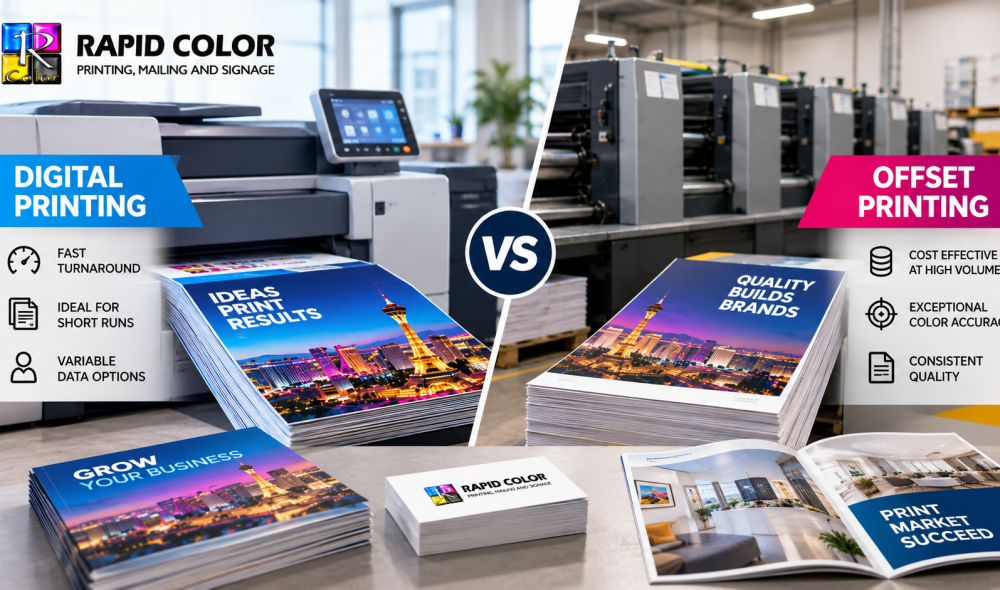
Digital vs Offset Printing: How to Choose the Right Method
Choosing a print process affects appearance, cost, color control, finishing, and delivery time. For brochures, catalogs, postcards, direct mail, and other marketing materials, digital vs offset printing is a practical production decision. Rapid Color, founded in Las Vegas in 1989 by Paul and Patsy Huckabay, has spent decades evaluating those variables on the press floor. If you are comparing local production capabilities, see Rapid Color’s Las Vegas Printing Company page for an overview of its commercial printing services.
Table of Contents
- Digital vs Offset Printing: The Core Difference
- How Offset Presses Lay Down Ink
- How Digital Presses Work
- Cost by Run Length
- Where Offset Gets Cheaper Per Piece
- The Break-Even Quantity to Watch
- Where Digital Wins on Short Runs
- Quality, Color, and Finish
- Pantone Matching on Offset
- Color Consistency on Digital
- Turnaround and Proofing
- How Rapid Color Chooses for Each Job
- FAQs on Digital and Offset Printing
Digital vs Offset Printing: The Core Difference
The simplest way to understand digital vs offset printing is to look at how the image reaches the sheet. Offset uses plates, ink units, pressure, and a controlled make-ready process. Digital production sends the prepared file directly to a digital press, where toner or ink is applied without traditional plates. That difference drives most practical tradeoffs.
How Offset Presses Lay Down Ink
Offset printing uses press units, commonly cyan, magenta, yellow, and black, to build an image. The plate transfers the image to a rubber blanket, which transfers it to paper. Operators adjust ink density, registration, and paper handling before production.
This setup is where much of the economic difference begins. Make-ready sheets are not part of the sellable quantity, and the press needs time to reach stable color. Once running correctly, a sheetfed offset press can produce large quantities efficiently.
How Digital Presses Work
Digital presses eliminate traditional plate-making. A digital front end processes the file and the press creates each sheet using toner or inkjet technology. This makes digital printing useful when quantity is limited, the deadline is tight, or each copy needs a different name, image, offer, or address.
Digital jobs can move from approval to output with fewer setup stages. Output can have different surface or color behavior by press and stock.
Cost by Run Length
The economics behind digital vs offset printing become clearer when quantity is considered. There is no universal break-even number because paper, size, coverage, finishing, and equipment affect the quote. Digital generally has a lower entry cost for short runs, while offset can have a lower unit cost as quantity increases.
| Factor | Digital | Offset |
|---|---|---|
| Best Fit | Short runs, versions, urgent jobs | Longer runs, stable designs |
| Setup | Minimal | Plates and make-ready |
| Unit Economics | Strong at lower quantities | Stronger as quantity rises |
| Personalization | Excellent | Limited compared with digital |
| Spot Color | Can simulate many colors | Strong choice for specified spot inks |
| Turnaround | Often faster for short jobs | More setup, efficient at scale |
Where Offset Gets Cheaper Per Piece
Offset has higher front-end costs because plates, make-ready, press setup, and calibration are part of production. Those costs are spread across the finished quantity. As the run grows, setup becomes a smaller portion of each piece.
That is why a 5,000-piece brochure can behave very differently from a 250-piece order. If the design is stable and the entire quantity is needed at once, an offset printing company may offer a better per-piece value. This is a central point in an offset vs digital cost comparison.
The Break-Even Quantity to Watch
For many jobs, the break-even point can fall somewhere from several hundred to a few thousand pieces, but that is only a planning range. A printer should calculate both methods from actual specifications.
The useful comparison is total delivered cost at the required quantity. A 750-piece premium job may favor one method, while a 2,500-piece simple flyer may favor another. In digital vs offset printing, quantity is not the only variable.
Where Digital Wins on Short Runs
Digital is often competitive when you need a small quantity without offset’s fixed setup. Short run vs long run printing depends on how fixed and variable costs behave.
Digital also handles multiple versions efficiently. Variable data can change names, addresses, QR codes, or images from sheet to sheet.
Quality, Color, and Finish
A common print quality comparison question is whether offset automatically looks better than digital. Modern equipment makes the answer more nuanced. Both methods can produce professional commercial work, but their strengths differ.
Pantone Matching on Offset
Offset is often preferred when a brand depends on specific spot colors or repeatable ink formulations. Pantone spot inks can be specified as part of press setup, useful for logos and corporate colors.
Color accuracy depends on paper, calibration, press condition, viewing light, and operator control. For independent industry context, PRINTING United Alliance’s G7+ guidance explains how modern color calibration can support consistent output across different printing technologies. G7+ is designed to work across traditional and digital print processes, with emphasis on gray balance, tonality, and color consistency.
On the press floor, operators review density, registration, gray balance, the approved proof, and the substrate. Paper changes how a color appears, especially on uncoated stock.
Color Consistency on Digital
Digital presses have become highly capable in color reproduction and consistency when the workflow is calibrated and the correct profile and stock are used. They are especially useful when a job contains frequent versions or variable data.
The same file can render differently on digital and offset equipment. Toner and inkjet systems respond differently to surface and paper coatings, so a print quality comparison should consider the actual press and stock.
Both processes can support cutting, folding, scoring, drilling, and laminating, but sheet characteristics and equipment compatibility affect efficiency.
Turnaround and Proofing
Turnaround is another important factor in digital vs offset printing. The deadline can change the recommendation even when quantity stays the same. Digital production generally requires fewer front-end steps, so short jobs can often move from approved file to printed sheets quickly.
Offset requires plates, make-ready, and color adjustment before the full run. For large quantities, that preparation can be worthwhile because the press becomes efficient once running.
A digital proof can quickly review layout, text, and general color direction. An offset proof or press check can be appropriate for exact stock, spot color, coating, or critical brand reproduction.
How Rapid Color Chooses for Each Job
Rapid Color treats digital vs offset printing as a production decision. The team considers quantity, paper, size, page count, color, finishing, personalization, deadline, and budget.
A small batch of postcards needed quickly may favor digital. A long catalog run may make more sense on offset. Strict Pantone requirements or unusual finishing may point toward offset, while personalized direct mail can benefit from digital.
The goal is to balance cost, appearance, consistency, and schedule. An experienced offset printing services provider should recommend the better fit rather than automatically assigning every job to one process.
For commercial printing methods, provide quantity, finished size, stock, pages, colors, finishing, and deadline so the production team can make a meaningful recommendation.
FAQs on Digital and Offset Printing
Is digital or offset printing cheaper?
Digital is usually more economical for short runs because there is little plate setup. Offset can become more economical as quantity increases because setup costs are spread over more pieces. The exact break-even point depends on the complete job specifications.
Is offset printing higher quality than digital?
Not automatically. Both can produce high-quality commercial work. Offset has strengths in spot-color control and long runs, while digital offers fast setup and personalization.
When should I use offset printing?
Consider offset when you need a larger quantity, consistent repeat production, specific spot colors, or a particular combination of stock and finishing. When to use offset printing should be decided from the complete production requirements rather than quantity alone.
Is digital printing faster?
For many short-run jobs, yes. Digital eliminates plate production and reduces setup time. Offset can still be fast once a press is running, especially at larger quantities.
Can digital printing match Pantone colors?
Digital systems can simulate many spot colors, but if an exact spot-color formulation is central to the project, offset with specified Pantone ink may provide a more direct path. Substrate and viewing conditions still matter.
How do I choose between digital and offset for my project?
Compare total cost at your actual quantity, required turnaround, color expectations, stock, finishing, and personalization. Digital vs offset printing should be selected according to the complete job requirements, not a generic quantity rule.
Conclusion
Digital vs offset printing is ultimately a question of fit. Digital offers speed and flexibility, while offset can deliver strong long-run economics and spot-color control. Rapid Color has helped businesses make these decisions since 1989.
Call Rapid Color at 702-792-6055 for a press recommendation based on your quantity, stock, color, finishing, and deadline.