
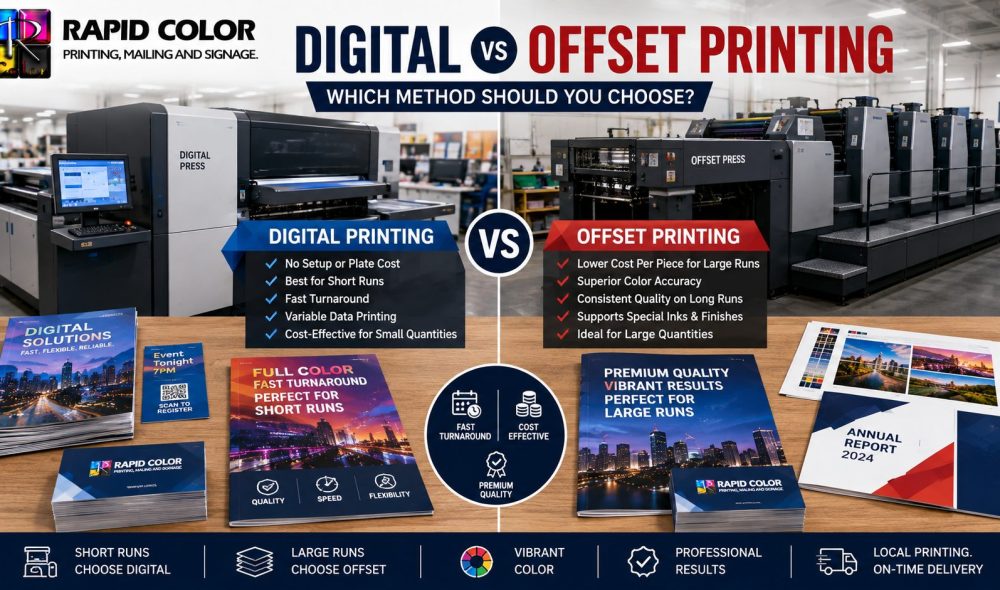
Ask two printers which process suits your job and you may get two different answers, both correct. The digital vs offset printing decision is not a question of which technology is better in the abstract; it is a question of quantity, timing, budget, and how much control you need over color. Get it right and you save money without noticing. Get it wrong and you either overpay for a short run or wait a week for something you needed on Friday. This guide sets out where the line actually falls. Most short-run work today runs through digital printing in Las Vegas presses, but that is only half the picture.
How Do Digital and Offset Presses Actually Work?
Understanding digital vs offset printing starts with the mechanics. Offset lithography transfers an inked image from a plate to a rubber blanket and then onto paper. Because each color requires its own plate, there is a fixed setup cost before the first sheet prints. Once running, however, an offset press produces sheets extremely quickly and extremely cheaply, so the cost per piece falls sharply as the run grows.
Digital presses skip plates entirely. Toner or liquid ink is applied directly to the sheet from a digital file, so there is no setup cost and effectively no minimum quantity. The trade-off is that the cost per sheet stays roughly flat no matter how many you print. That single structural difference explains almost everything about digital vs offset printing economics.
The Breakpoint That Decides Most Jobs
For typical full-color commercial work, the crossover sits somewhere between 500 and 1,500 pieces, depending on sheet size, ink coverage, and finishing. Below that range, digital wins on cost almost every time. Above it, offset pulls ahead and keeps pulling ahead. At 10,000 brochures the gap is not marginal; offset can be less than half the price. This single figure resolves most digital vs offset printing arguments before they start.
Ask your printer to quote both ways whenever your quantity sits near that band. A competent estimator will run the digital vs offset printing comparison as a matter of course, because the answer shifts with paper price, coverage, and press availability in a given week.
Cost: Where the Money Actually Goes
Cost is the first thing buyers compare in digital vs offset printing, and the structure differs completely. Offset carries plate charges, make-ready waste, and press setup time. Those costs are incurred whether you print 500 sheets or 50,000, which is why short offset runs feel absurdly expensive. Digital carries a higher click cost per impression but no setup, so a run of 100 costs almost exactly one tenth of a run of 1,000.
There is a second cost most buyers overlook: reprint risk. If your literature changes quarterly, printing 20,000 offset copies to hit a lower unit price is a false economy when 14,000 go in a skip. Digital vs offset printing decisions should account for shelf life, not just unit cost.
Quality: A Narrower Gap Than It Used to Be
Fifteen years ago the quality side of digital vs offset printing was straightforward. Offset produced richer solids, smoother gradients, and more accurate spot colors; digital produced a visibly toner-like sheen. Modern liquid-ink digital presses have closed most of that gap, and for standard commercial work, ordinary buyers cannot reliably tell the two apart.
Offset still holds four advantages worth knowing when weighing digital vs offset printing. It reproduces Pantone spot colors exactly rather than simulating them in process inks, which is why offset printing in Las Vegas remains standard for brand-critical packaging. It handles very large sheets and heavier boards more comfortably. It supports specialist inks such as metallics and fluorescents. And on very long runs, it maintains color consistency from first sheet to last with fewer drift corrections.
When Color Accuracy Decides the Method
If your brand lives or dies on an exact corporate color, that requirement alone can settle the digital vs offset printing question. Packaging, annual reports, and premium collateral frequently justify offset for this reason, and color printing in las vegas for those categories is still largely plate work. For everyday color printing in las vegas work such as flyers, price lists, and internal documents, digital reproduction is more than sufficient and considerably faster. Color is the one area where digital vs offset printing still produces a genuinely visible difference, and only on specific jobs.
Turnaround: Speed Is Digital’s Strongest Argument
Speed is where digital vs offset printing separates most decisively. Digital removes plate-making, mounting, and make-ready from the schedule. A digital job can be printing within minutes of file approval, which is why same-day and next-day work is almost always digital. Offset needs plates produced, a press made ready, and color brought up to standard before the run begins, which typically adds a day or more.
For anything driven by an event date, the digital vs offset printing choice usually resolves itself. When a convention opens Monday and artwork lands Thursday, quantity stops being the deciding factor.
Variable Data: A Capability Offset Simply Does Not Have
One capability sits entirely outside the digital vs offset printing balance sheet. Digital presses can change content on every sheet without slowing down. Names, addresses, account numbers, unique codes, and personalized offers can vary across an entire run. Offset cannot do this at all, because the plate is fixed.
That capability has quietly reshaped direct mail. Personalized mailers consistently outperform generic ones, and the difference is large enough that many marketers now choose digital even at quantities where offset would be cheaper. In those cases the digital vs offset printing calculation is about response rate rather than unit price.
Which Method Suits Which Job?
The practical digital vs offset printing rule is short. Choose digital for short runs under roughly 500 pieces, urgent deadlines, personalized or variable content, prototypes and proofs before a longer run, and any project where the content changes frequently. Business cards, event flyers, short-run booklets, and test mailings all sit comfortably here. Fast-turnaround digital printing in Las Vegas covers almost all of these categories.
Choose offset for runs above roughly 1,500 pieces, jobs requiring exact Pantone matching, oversized sheets, heavy or unusual stocks, specialist inks and finishes, and long-life materials such as catalogues and packaging. Our article on when offset printing makes sense works through the volume mathematics with worked examples.
The Hybrid Approach Most Businesses End Up Using
In practice, few companies settle the digital vs offset printing question once and apply it to everything. A typical annual print program runs its long-life catalogue and packaging on offset while producing event materials, personalized mail, and quarterly updates digitally. Treating digital vs offset printing as a per-job decision rather than a company policy is what keeps overall print spend efficient.
A useful habit is to print a small digital run first to validate design and copy, then commit to an offset run once the piece has proved itself. Handled this way, the two processes stop being an either-or choice and become a sequence. That approach costs slightly more overall but eliminates the expensive mistake of discovering a typo on sheet 12,000.
Rapid Color operates both digital and offset presses in one Las Vegas facility, which means a job can be quoted honestly on its merits rather than pushed toward whichever process a supplier happens to own. Multi-page pieces such as folded literature sit right on the crossover point, so it is worth quoting brochure printing both ways before committing, and confirming which press your offset printing in Las Vegas quote assumes.
Frequently Asked Questions
What is the main difference between digital and offset printing?
In digital vs offset printing, offset uses plates to transfer ink through a rubber blanket onto paper, creating a setup cost but a very low cost per sheet at volume. Digital prints straight from a file with no setup, making short runs fast and affordable.
At what quantity does offset become cheaper than digital?
The crossover usually falls between 500 and 1,500 pieces for standard commercial work. Sheet size, ink coverage, paper choice, and finishing all shift that point, so request quotes both ways whenever your quantity sits anywhere near that range.
Is offset printing better quality than digital?
Offset still leads on exact Pantone matching, heavy stocks, oversized sheets, and specialist inks such as metallics. For everyday commercial work, modern digital presses produce results most buyers cannot distinguish from offset at normal viewing distance.
Which method is faster for urgent jobs?
Digital is substantially faster because it skips plate-making and press make-ready entirely. A digital job can begin printing within minutes of file approval, which is why same-day and next-day printing is almost always produced on digital presses.
Can offset printing handle personalized content?
No. Offset plates are fixed, so every sheet in a run comes out identical. Personalization, variable addressing, and unique codes all require digital presses, which change content on every single sheet without reducing press speed.
Does digital vs offset printing affect paper choice?
Somewhat. Offset accommodates a wider range of heavy boards, textured stocks, and oversized sheets. Digital presses have tighter thickness and size limits, although modern equipment handles most standard commercial paper weights without difficulty.
Should I proof digitally before an offset run?
Yes, and it is standard best practice. A short digital run lets you check copy, layout, color, and finishing at low cost, so errors surface before you commit to a long offset run where corrections become expensive.