
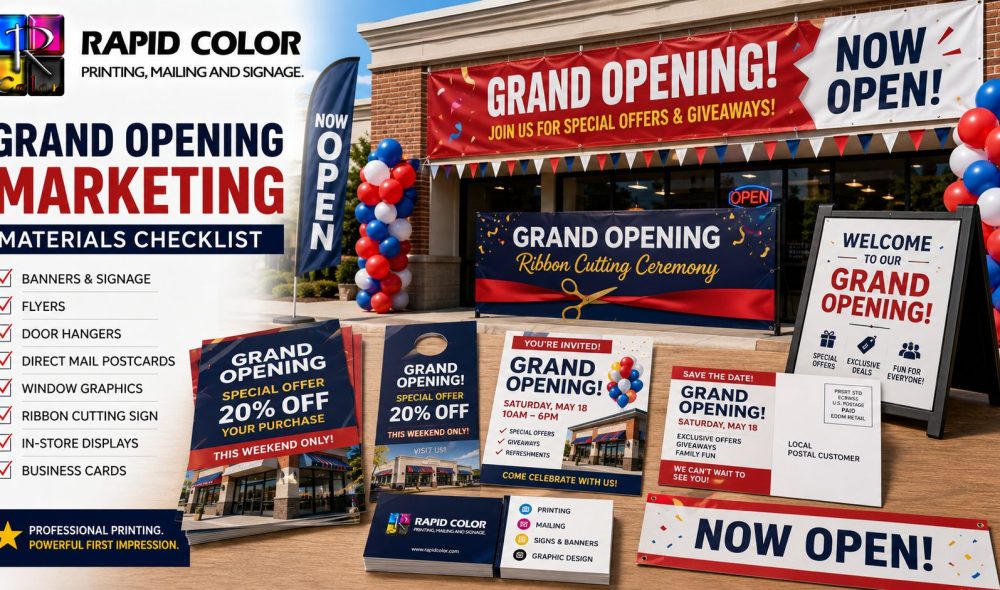
A grand opening is the only day your business gets to be new. Once that window closes, you spend years and considerably more money trying to buy the attention that opening week hands you almost for free. The businesses that convert that moment into lasting customers are rarely the ones with the biggest budget; they are the ones whose grand opening marketing began six weeks early and covered every point where a neighbor might notice them. This guide walks through the printed pieces that do that work, in the order you should produce them. Most launch plans start with flyer printing in las vegas because flyers are the cheapest way to test a message before committing to larger formats.
Why Printed Grand Opening Marketing Still Outperforms Digital Alone
Almost every launch plan now begins online, yet the strongest grand opening marketing results still come from physical materials. Social posts reach people who already follow you, which on launch week is usually your staff and your family. A new business has no audience yet. Print solves that problem because it does not require a prior relationship: a banner is seen by everyone who drives past, a door hanger reaches a household whether or not it has heard of you, and a mailed postcard lands in a hand rather than a spam folder.
There is also a trust dimension. A professionally produced sign or postcard signals permanence. It tells a neighborhood that the business intends to stay, which matters enormously in retail corridors where storefronts turn over every eighteen months. Effective grand opening marketing uses print to establish credibility and digital to amplify it, not the other way around.
Building a Realistic Six-Week Timeline
Six weeks out, order exterior signage and banners. Four weeks out, produce flyers and door hangers for distribution. Three weeks out, drop your direct mail so it lands in the window when people are still planning their weekends. Two weeks out, finalise in-store materials: window graphics, counter cards, menus or price lists, and loyalty cards. One week out, print the day-of pieces, including the ribbon-cutting backdrop and any staff name badges.
Compressing that schedule is possible but expensive. Every stage of grand opening marketing that slips into rush production adds cost without adding reach, so the calendar is the first thing to lock down.
The Core Grand Opening Marketing Materials Checklist
Exterior Banners and Coming Soon Signage
Your building is your largest and cheapest advertisement. A “Coming Soon” banner installed four to six weeks before opening does something no other piece can: it markets to the exact people who already travel past your location daily. Follow it with an “Opening Saturday” banner, then a “Now Open” banner. Three banners cost less than a week of paid social and work continuously, which is why they anchor nearly every grand opening marketing budget we quote.
Specify 13 oz scrim vinyl with hemmed edges and grommets every two feet for outdoor use, and add wind slits if your frontage is exposed. In desert climates, ask for UV-stable inks so the color holds through a hot summer.
Permanent Storefront Signage
Temporary banners buy you time; permanent signage earns the years afterwards. Channel letters, illuminated cabinets, monument signs, and window lettering all fall under custom business signs, and all of them require permits in most jurisdictions. Start that approval process early, because permitting frequently takes longer than fabrication and is the single most common cause of a delayed opening. Nothing else in your launch plan can compensate for a storefront with no name on it.
If your permanent sign will not be installed in time, plan a high-quality temporary alternative rather than opening with a blank facade. A blank building undoes weeks of grand opening marketing in a single afternoon.
Flyers and Door Hangers
Flyers remain the workhorse of neighborhood launch campaigns. Print a straightforward offer, a date, an address, and a map, then distribute within a one-mile radius. Door hangers perform even better because they cannot be ignored the way a flyer under a wiper can. Both formats are inexpensive enough to test two versions and keep the winner for the next location, which makes flyer printing in las vegas the natural starting point for grand opening marketing on a tight budget.
Keep the offer simple. “Twenty percent off opening weekend” outperforms a tiered promotion every time, because a flyer gets three seconds of attention.
Neighborhood Direct Mail
Direct mail printing reaches households that never walk your block, which is precisely the audience a new business cannot otherwise touch. Every Door Direct Mail lets you target by postal carrier route without renting a list, making it one of the most cost-efficient tools in any grand opening marketing plan. Our guide to EDDM in Las Vegas explains route selection and postage tiers in detail.
Send twice rather than once. A single mailer produces a small spike; two mailers spaced ten days apart produce recognition, and recognition is what converts. Treat the second drop as a fixed line item rather than an optional extra.
Ribbon Cutting and Event-Day Pieces
Opening day itself needs its own short list: a step-and-repeat backdrop for photographs, an oversized ribbon and ceremonial scissors, a welcome A-frame at the entrance, table tents for any food or drink stations, and staff badges so visitors know whom to ask. Chambers of commerce photograph these events and share the images widely, so the backdrop earns its cost through borrowed reach. These pieces are also the most visible part of your grand opening marketing, because they appear in every photograph taken that day.
In-Store Materials Guests Take Home
The final piece of grand opening marketing is what leaves with the customer. Loyalty cards, discount cards for a return visit, branded bags, and a simple menu or service card all extend opening day into week two. A first-visit discount card redeemable only on a second visit is the highest-return item on this entire list, and it converts one day of attention into a measurable habit.
How Much Should a Grand Opening Marketing Budget Be?
Most independent businesses allocate between two and five percent of first-year projected revenue to launch marketing, with roughly sixty percent of that going to print and signage. For a small retail operation, that often means a total launch print spend somewhere between two and six thousand dollars, excluding permanent signage, which is normally capitalised separately as a build-out cost.
Spend the grand opening marketing budget where reach is highest per dollar. Banners and door hangers deliver the most impressions per dollar. Direct mail delivers the most qualified traffic. Event-day pieces deliver the least measurable return but protect the impression your other grand opening marketing worked so hard to create, so they are difficult to cut entirely.
Coordinating It All Through One Printer
Splitting a launch across four suppliers creates four delivery dates, four color interpretations of your logo, and four people to chase during the week you can least afford it. A single full-service partner handling banners, flyers, mail, and signage keeps your brand color consistent and your timeline visible in one place, and it removes the largest coordination risk from the whole launch.
Rapid Color produces launch packages for new Las Vegas businesses across retail, hospitality, fitness, and professional services, with signage, mail, and event materials produced under one roof. That matters most in the final fortnight, when artwork changes arrive late and grand opening marketing deadlines stop being flexible. Businesses planning permanent exterior work should review options for custom business signs alongside their temporary pieces, and coordinate mailing dates with a direct mail printing schedule so both land in the same week.
Frequently Asked Questions
What materials do I need for a grand opening?
Grand opening marketing needs, at minimum, an exterior banner, flyers or door hangers, a direct mail piece, storefront signage, and event-day items such as a photo backdrop and A-frame. Add take-home pieces like loyalty cards to extend traffic past opening weekend.
How far in advance should grand opening marketing start?
Begin grand opening marketing six weeks out. Order signage and banners first, flyers at four weeks, direct mail at three weeks, in-store materials at two weeks, and event-day items in the final week. Permits for permanent signs should start even earlier.
How many flyers should I print for a launch?
Plan roughly one flyer per household within a one-mile radius, then add twenty percent for redistribution. Most small launches print between two and five thousand, which keeps the per-piece cost low enough to justify a second drop.
Does direct mail work for a brand new business?
Yes, particularly Every Door Direct Mail, which reaches whole carrier routes without a purchased list. It is often the only channel that reaches households outside your immediate block, and two mailings outperform one significantly.
What size banner works best for a storefront?
A 3 ft by 8 ft or 4 ft by 10 ft banner suits most retail frontages and stays readable from passing traffic. Match the width to your facade rather than maximising size, and keep the message to five words or fewer.
Do I need permits for grand opening signage?
Permanent exterior signs almost always require permits, and some jurisdictions also regulate temporary banners by size and duration. Check local rules before ordering, since approval timelines are the most common cause of a delayed opening.
Can all launch materials be printed by one company?
Yes, and consolidating grand opening marketing with one printer is strongly recommended. A single supplier means matching brand color across banners, mail, and signage, a single delivery schedule, and one point of contact when last-minute changes appear during launch week.