
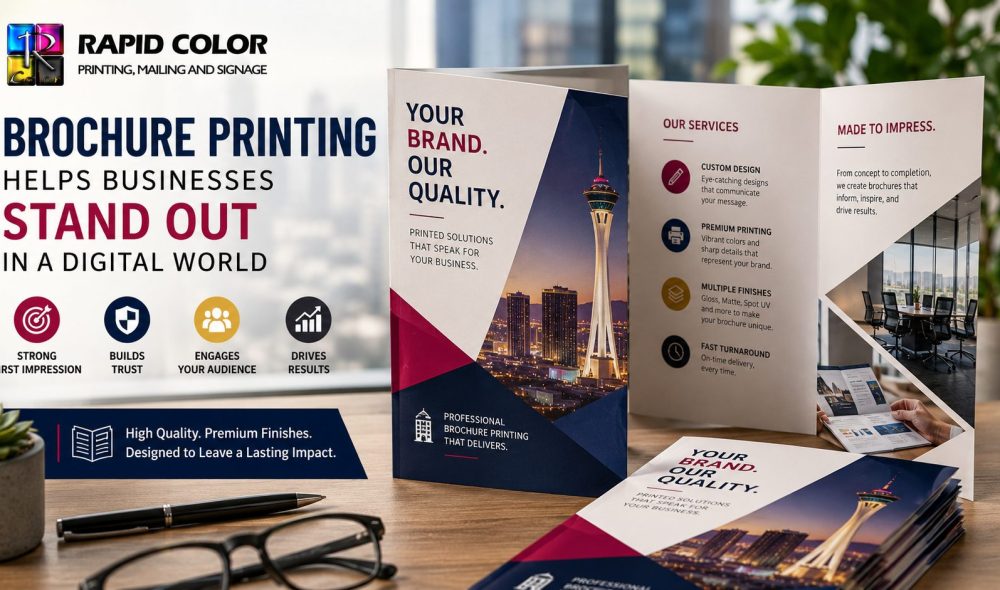
Every marketing team now competes for attention inside the same crowded feed. Ad costs climb, inboxes fill, and the average viewer scrolls past a paid placement in under two seconds. Against that backdrop, something physical carries disproportionate weight, which is why brochure printing has quietly returned to the center of many marketing budgets rather than disappearing from them. A well-produced brochure occupies desk space, gets passed between colleagues, and stays readable long after a digital campaign has expired. It is not nostalgia driving this shift. It is measurable attention, and attention has become the scarcest resource any business buys.
Why Print Cuts Through Digital Noise
Screens demand constant triage. A person opening a laptop faces notifications, tabs, and competing messages, and the brain learns to dismiss nearly all of it. A printed piece arrives in a different context entirely. There is nothing else on the page competing for the eye, no adjacent advertisement, and no algorithm deciding whether the message appears at all.
Neuroscience research into print advertising has consistently found stronger recall and emotional response for physical materials than for equivalent digital versions. Weight, texture, and the physical act of turning a panel all contribute. Brochure Printing takes advantage of that difference deliberately, delivering information at a pace the reader controls.
There is also a trust dimension. Producing a printed piece requires commitment. Anyone can launch a website overnight, but a company that invests in professional Brochure Printing signals permanence, and buyers read that signal even when they never consciously articulate it.
How Does Brochure Printing Support a Digital Strategy?
The framing of print against digital is a false choice. The strongest campaigns treat the two as a loop rather than as rivals.
Print Opens the Door, Digital Closes It
A brochure handed over at a trade show or left in a hotel lobby introduces the offer. A QR code, short URL, or personalized landing page carries the reader to a booking form or product configurator. The print piece supplies credibility; the digital layer supplies conversion and tracking.
Print Reaches People Digital Cannot
Ad blockers, spam filters, and privacy restrictions have made digital targeting less reliable each year. Brochure Printing bypasses all of it. Materials placed at reception desks, mailed to a purchased list, or handed out at events reach recipients regardless of their browser settings.
Print Survives the Buying Cycle
Considered purchases take weeks or months. Brochure Printing sitting in a procurement folder keeps working across that entire window at zero incremental cost after the initial run.
Brochure Printing Formats That Shape the Message
Format is a strategic decision, not a cosmetic one. Each fold changes how information is revealed.
Bi-Fold
Four panels, generous space per panel, and a straightforward reading order. Best for narrative-driven material such as company overviews or service explanations that benefit from larger imagery.
Tri-Fold
The workhorse of Brochure Printing. Six panels fit a standard business envelope, making it ideal for mailing and rack display. The structure suits segmented content: problem, solution, proof, and call to action.
Gate Fold
Two outer panels open to reveal a wide interior spread. Excellent for a dramatic product reveal, architectural imagery, or a timeline that needs uninterrupted width.
Booklet and Saddle-Stitched
Once content exceeds eight panels, a stitched booklet reads better than any fold. Common for catalogs, capability statements, and detailed technical specifications.
Paper, Ink, and Finish Decisions in Brochure Printing
The physical specification is where a brochure either feels premium or feels disposable.
Stock Weight
Text-weight stock around 100 lb works for multi-page booklets where flexibility matters. For single-fold pieces, 100 lb cover gives the rigidity that makes a brochure feel considered in the hand. Anything thinner curls in a rack and telegraphs a cut corner.
Coatings and Finishes
Gloss coating maximizes color saturation and suits photography-heavy layouts. Matte and soft-touch finishes reduce glare and read as more sophisticated, which suits professional services. Spot UV applied selectively over a logo or headline creates contrast that photographs beautifully and costs far less than full-piece specialty treatment.
Color Accuracy
Consistent Color Printing is what separates professional work from output that looks slightly wrong without the viewer knowing why. Brand colors reproduced through a proper Pantone match rather than an approximate process build keeps a brochure aligned with signage, packaging, and digital assets. This detail matters more in Brochure Printing than almost anywhere else, because brochures are often held directly beside other branded materials.
Where Brochure Printing Delivers the Most Value
Rather than thinking about brochures as a single deliverable, consider the touchpoints where a printed piece outperforms a link:
1. Trade shows and conventions — attendees collect physical material and review it on the flight home, when digital follow-up has not yet arrived.
2. Reception areas and waiting rooms — captive attention with no competing screen demands.
3. Direct mail campaigns — a brochure inside an envelope earns far more dwell time than a postcard alone.
4. Sales meetings — a leave-behind keeps the conversation alive with stakeholders who were not in the room.
5. Hotel and visitor racks — particularly effective for tourism, dining, and entertainment businesses in high-traffic corridors.
6. Product packaging inserts — an inexpensive way to cross-sell to customers already holding your product.
7. Real estate and property tours — floor plans and specifications that prospects annotate by hand.
In a convention-driven market, Brochure Printing Las Vegas campaigns often lean heavily on the first and fifth of these, where foot traffic is enormous and competition for the eye is fierce.
Designing for the Hand, Not the Screen
Layouts built for web rarely survive translation to paper. Line lengths that work on a wide monitor become unreadable in a narrow panel. Light gray body text that passes on a bright display disappears on uncoated stock.
Effective Brochure Printing design respects a few durable principles. Establish one clear focal point per panel. Keep body copy between ten and eleven points with generous leading. Maintain at least an eighth of an inch of clearance between text and any fold. Build files at 300 dpi in CMYK with proper bleed, because an image that looks sharp on screen can arrive noticeably soft in print.
For a deeper look at production techniques and finishing options, this guide to brochure printing techniques covers the specification choices that most influence the finished result.
Measuring Return on Brochure Printing
The old complaint about print was that it could not be tracked. That is no longer accurate.
Unique QR codes assigned to each distribution channel show exactly which venue or event generated scans. Dedicated landing page URLs separate brochure-driven traffic from all other sources. Distinct phone numbers attribute inbound calls precisely. Offer codes printed on the response panel tie revenue directly to a specific run.
Cost per impression also deserves a fair comparison. A brochure produced at well under a dollar per unit that a prospect keeps for three weeks compares favorably against digital impressions measured in fractions of a second. Serious color printing programs are evaluated on retained attention, not on impressions delivered.
Choosing a Brochure Printing Partner That Delivers
Not every supplier produces equal work. Before committing to a run, ask whether you can see a printed proof on your actual stock, whether Pantone colors are matched precisely, and whether the shop can handle folding, scoring, and mailing under one roof. Scoring in particular is where inexpensive printing fails, since heavy stock folded without a proper score cracks along the spine and ruins an otherwise strong piece.
A capable las vegas printing company will also advise on postal requirements before production rather than after. Rapid Color has run digital, offset, and specialty finishing work in this market for more than three decades, and that combination lets a single supplier carry a project from proof through mailing without handoffs that introduce color drift.
Businesses evaluating Brochure Printing Las Vegas options should weigh turnaround honestly as well. Rush schedules restrict stock availability and eliminate specialty finishes, so building in two extra weeks usually produces a better piece for the same money.
The Case for Print in a Screen-First Market
Digital channels are not going anywhere, and no serious marketer would argue they should. But saturation has changed the arithmetic. When every competitor is bidding on the same keywords and appearing in the same feeds, the differentiated move is often the physical one. Brochure Printing gives a business something a competitor’s ad cannot replicate: a tangible object that occupies real space in a prospect’s world and holds attention on the reader’s own terms. Specified thoughtfully, printed properly, and connected to a digital follow-up path, a brochure remains one of the most durable investments in a marketing plan.
Frequently Asked Questions About Brochure Printing
Is print still effective compared with digital advertising?
Yes. Printed material generates stronger recall and longer engagement than equivalent digital placements. It works best alongside digital channels, with QR codes or dedicated URLs carrying readers from the printed piece to an online conversion point.
Which brochure fold works best for most businesses?
The tri-fold suits the majority of applications. Six panels fit standard envelopes and display racks, and the segmented structure naturally organizes content into problem, solution, proof, and call to action without overwhelming the reader.
What paper weight should a brochure use?
For single-fold pieces, 100 lb cover provides rigidity that feels professional in hand. Multi-page booklets work better on 100 lb text weight, which folds and stitches cleanly without adding unnecessary bulk or mailing cost.
How many brochures should be ordered at once?
Order enough to cover roughly six months of distribution. Per-unit cost falls sharply as quantity rises because setup is fixed, but printing more than you can distribute before the content changes wastes money.
Can results from a printed brochure be tracked?
Yes. Unique QR codes, dedicated landing pages, distinct phone numbers, and printed offer codes all attribute response to specific distribution channels, allowing accurate measurement of which venues and events produce actual leads.
How long does production usually take?
Standard runs typically complete within five to seven business days after proof approval. Specialty finishes such as soft-touch lamination, foil, or spot UV add several days, so allow two weeks for anything beyond a standard specification.
Should files be supplied in RGB or CMYK?
Always supply CMYK at 300 dpi with an eighth-inch bleed. RGB files convert unpredictably and often shift noticeably in saturated blues and greens. Supplying press-ready files avoids surprises at the proofing stage.