The Finest Materials and Finishes Available for Pocket Folder Printing
Choosing the right paper and finish is the most important decision in Pocket Folder Printing. A folder is often the first item a client holds during a meeting, so it must look professional and last through daily use. If you want a local partner, Rapid Color offers pocket folder printing in Las Vegas with many stock and finish options. This guide explains the main materials, coatings, and special effects so you can choose with confidence.
Understanding Paper Stocks for Pocket Folder Printing
Paper stock controls how a folder feels, how strong it is, and how the colors appear. Most custom pocket folders use heavy cover stock, commonly between 12pt and 16pt. A thicker sheet holds its shape better, but it costs more and can be harder to fold cleanly.
Coated Cover Stock
Coated stock has a smooth surface that keeps photos and bold colors sharp. It is the most common choice for Pocket Folder Printing because it holds ink well and works with almost every coating.
Uncoated and Textured Stock
Uncoated stock has a natural, slightly absorbent surface. Colors look softer, and the folder can be written on with a pen. Linen and felt textures add a traditional look. These papers suit law firms and schools that prefer a quiet style. Some finishes do not bond well to uncoated paper, so ask your printer before planning special effects for this type of Pocket Folder Printing job.
Coatings and Finishes That Protect Your Folder
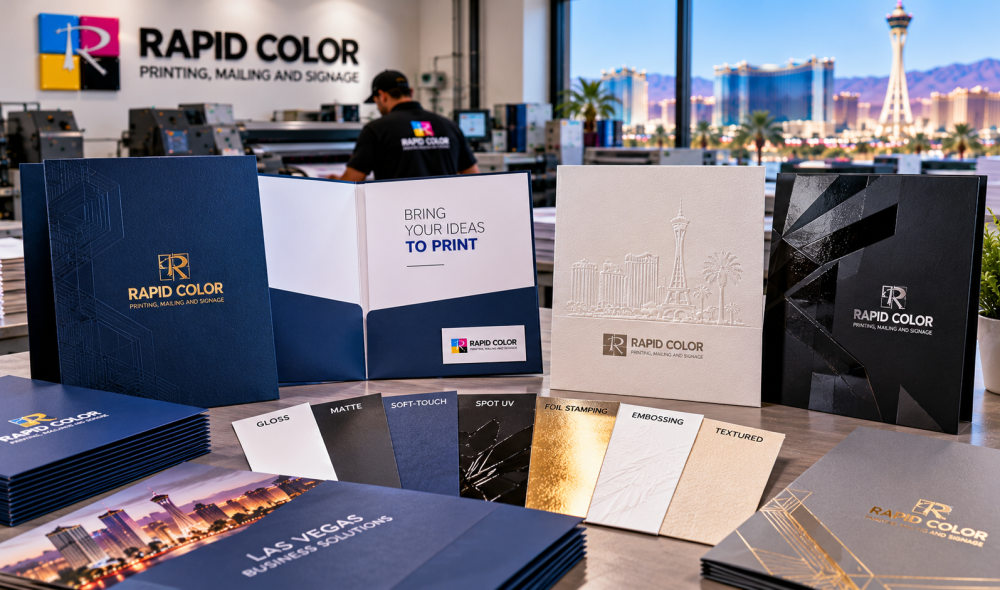
A finish protects the printed surface and changes how the folder looks and feels. In presentation folder printing, the finish often separates an average folder from a memorable one. Good Pocket Folder Printing starts with a clear decision about the finish.
Gloss and Matte Coatings
Gloss coating deepens color and reflects light, which works well for photo-heavy designs. Matte coating reduces glare and gives a clean, modern look. Both help guard against scuffs during handling.
Soft-Touch Lamination
This finish gives the surface a smooth, velvety feel. Many buyers choose it for executive folders. It adds some scuff resistance, although very dark colors can show marks over time.
Spot UV Coating
This clear, glossy layer is applied only to selected areas, such as a logo or a pattern. When it sits on a matte or soft-touch background, the contrast is easy to see. Many designers pair spot UV coating with a soft-touch base for this reason.
Foil Stamping and Embossing
This process presses a thin metallic layer onto the paper in gold, silver, or other colors. Embossing raises part of the design so it can be felt as well as seen. Rapid Color offers foil stamping and embossing services, and these effects can be combined on one folder. Because they need extra setup, plan for more production time in your Pocket Folder Printing schedule.
Comparing Common Material and Finish Choices
Pocket Folder Printing choices are easier to make when the options sit side by side. The table below summarizes the main points.
|
Option |
Look and Feel |
Best For |
Keep in Mind |
|
Coated stock with gloss |
Bright, rich color |
Photo-heavy designs |
Can show glare |
|
Coated stock with matte |
Smooth, low glare |
Corporate use |
Colors look slightly softer |
|
Uncoated or textured stock |
Natural, writable |
Law, education, non-profits |
Colors look less vivid |
|
Soft-touch lamination |
Velvety, premium |
Executive and client folders |
Dark colors can show marks |
|
Spot UV coating |
Shiny highlights |
Logos and patterns |
Needs a clear design plan |
|
Metallic foil |
Metallic shine |
Logos and titles |
Higher cost, more time |
The right pick depends on your brand, your budget, and how the folder will be used.
What to Consider Before You Order
Pocket and Size Details
A standard 9 x 12 inch folder holds letter-size pages without bending them. Check pocket depth and ask about business card slits if you plan to include a card. Make sure any inserts fit inside the pocket. Matching brochure printing can help you build a complete sales kit.
Artwork Preparation
Ask for the die line template before design begins. Add bleed, usually 0.125 inch, and keep text away from folds and pocket edges. Use CMYK colors, and mark foil or Spot UV areas on a separate layer. If your brand has a fixed color, check it with the Pantone Color Finder and give your printer the exact code. Many problems in Pocket Folder Printing come from files that ignore the template, so this step saves time and money.
Budget and Quantity
Special effects raise cost because they add materials, setup, and handling. Digital printing suits short runs, while offset printing is usually better value for larger quantities. One strong effect, such as Spot UV on the logo, often works better than several. Pocket Folder Printing works best when the budget goes where the reader will notice it most.
Choosing a Printer
When comparing options for Pocket Folder Printing, ask to see samples of the finishes you are considering. A full-service Las Vegas printing company can advise on stock, coatings, and schedule in one conversation.
Frequently Asked Questions
What is the best paper stock for Pocket Folder Printing?
For most projects, 14pt or 16pt coated cover stock is a reliable choice. It is strong, takes color well, and accepts gloss, matte, soft-touch, and Spot UV finishes. Uncoated stock is better when you want a natural look.
Is soft-touch lamination worth the extra cost?
It can be, when the folder is meant to impress high-value clients. For internal or high-volume use, a standard matte or gloss coating is usually enough.
Can foil stamping be combined with Spot UV on one folder?
Yes. Many printers combine foil, embossing, and Spot UV on the same piece. Plan the layout early so each effect has its own clear area. Combined effects take longer, so confirm the schedule first.
How thick should custom pocket folders be?
Most buyers in Pocket Folder Printing choose 14pt or 16pt stock. Thinner paper can bend when the pockets are full, while very thick stock can crack at the fold if it is not scored correctly.
How long does presentation folder printing take?
Standard orders often take about five to seven business days, but timing depends on quantity, stock, and finish. Foil, embossing, and combined effects add time, so confirm the schedule before you commit to a deadline.
Do I need a die line template for Pocket Folder Printing?
Yes. The die line shows where the folds, pockets, and cut edges will fall. Without it, logos or text may land too close to an edge. Using the template is one of the simplest ways to avoid delays in Pocket Folder Printing.
Conclusion
The best materials and finishes for Pocket Folder Printing depend on how your folder will be used. Coated stock suits color-rich designs, uncoated stock suits a quiet style, and finishes such as soft-touch lamination, Spot UV, and foil add a premium touch. Whether you order custom pocket folders for sales teams or for events, request samples and review the proof carefully. With the right planning, Pocket Folder Printing and presentation folder printing can deliver a polished, durable piece that supports your brand. For more details, talk with a printer about your project.