
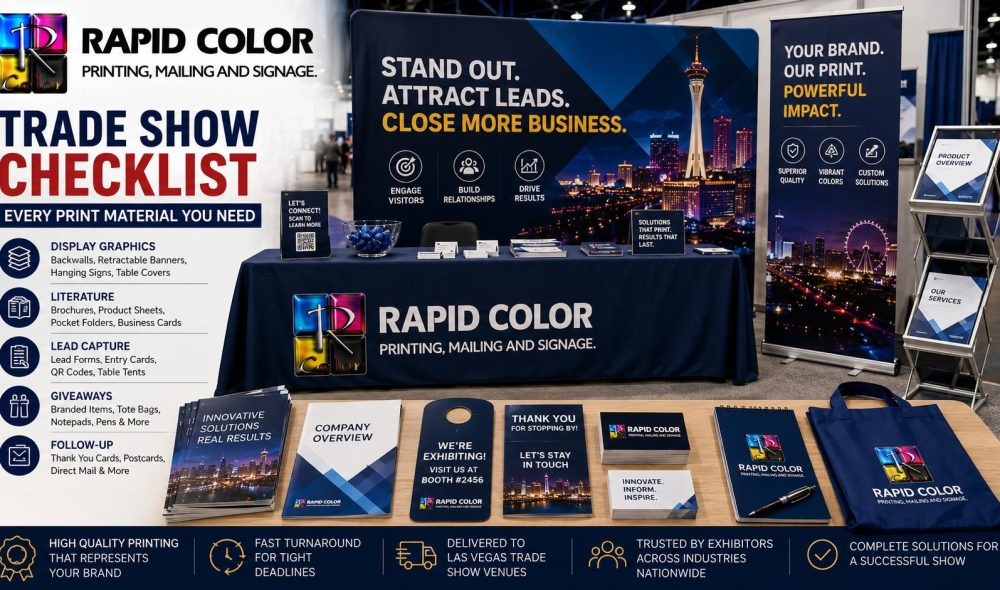
Exhibitors rarely lose a show because their product was wrong. They lose it because a box did not arrive, a banner was the wrong size for the booth, or they ran out of literature before lunch on day two. Trade show materials are the least glamorous part of an exhibit budget and the part most likely to decide whether the investment pays back. This checklist covers every printed item a booth needs, organized by function, with realistic quantities and lead times attached. Exhibitors working Nevada shows usually anchor the list with a convention printing in Las Vegas partner who can deliver straight to the hall.
What Trade Show Materials Does an Exhibitor Actually Need?
A functional booth requires four categories of trade show materials: display graphics that attract attention from a distance, literature that explains the offer up close, capture tools that record interest, and follow-up pieces that convert that interest after the show. Skipping any one category breaks the chain. Beautiful graphics with no literature produce admiration and no pipeline; excellent literature behind an invisible booth produces nothing at all.
Build your list by category rather than by item. It is the fastest way to notice that you have budgeted four thousand dollars of trade show materials for attracting visitors and nothing at all for following up with them.
Category One: Display Graphics That Pull Traffic
Backwall and Booth Graphics
Your backwall is read from twenty to thirty feet away, which means it must survive being reduced to a logo and five words. Tension fabric backwalls have largely replaced rigid panels because they pack smaller, resist creasing, and avoid the glare that ruins photographs. Whatever substrate you choose, keep critical content above forty inches so it clears heads in a busy aisle. Backwalls are the most expensive trade show materials most exhibitors buy, so specify the substrate before designing to it.
Retractable Banner Stands
Retractable stands are the most reusable trade show materials an exhibitor owns. They set up in under a minute, travel in a padded case, and take replacement graphics for the next show at a fraction of the original cost. Two flanking a booth entrance outperform one centered behind a table, and they remain the display piece most exhibitors reuse across a full season. Our guide to retractable banner stands covers hardware grades and graphic replacement in detail.
Table Covers, Runners, and Counter Wraps
Banner printing las vegas vendors produce these alongside display graphics, so order them together. A six-foot table with a generic black cloth looks rented. The same table with a dye-sublimated branded cover looks like a company that planned. Counter wraps do the same for demo stations. These are inexpensive trade show materials with a disproportionate effect on how professional a booth reads in photographs, and they need no assembly on site.
Hanging Signs and Overhead Banners
If your booth is twenty by twenty or larger, most halls allow a hanging sign, and it is the only element visible from the far end of the aisle. Confirm height limits and rigging rules with show services before ordering, because banner printing las vegas suppliers can build to any dimension but cannot change a venue’s ceiling rules. Hanging graphics are the trade show materials most often rejected on site for compliance reasons.
Category Two: Literature Attendees Take Away
Brochures and Product Sheets
Printed literature still closes deals because attendees compare vendors on the plane home, not at the booth. Of all trade show materials, brochures have the longest useful life after the hall closes. A short brochure with clear specifications outperforms a thick catalogue nobody carries. For multi-product exhibitors, brochure printing in Las Vegas usually means a slim overview brochure plus individual product sheets; visitors receive only what applies to them, which reduces waste and improves recall. Standard brochure printing in Las Vegas turnarounds comfortably accommodate a show schedule if artwork is approved two weeks out.
Business Cards and Contact Pieces
Bring three times as many cards as you think you need, and give every staff member their own supply. A card with a QR code linking to a booth-specific landing page turns a paper exchange into a measurable one, and it links your trade show materials directly to reportable traffic.
Pocket Folders and Press Kits
Media attending larger shows expect a press kit, which is one of the few trade show materials worth producing at a higher specification than everything else. A pocket folder holding a one-page release, a spec sheet, and a contact card is still the format journalists prefer, because it survives a day of collecting without disintegrating.
Category Three: Capture and Qualification Tools
Lead Forms and Entry Cards
Not every prospect wants a badge scan. Printed entry cards for a prize draw capture contact details from visitors who would otherwise walk past, and they double as a qualification tool if you add two tick-box questions. These are the cheapest trade show materials on the list and frequently the highest-returning.
Table Tents and Talking Points
Small printed table tents that answer the three questions your team hears most reduce the load on staff and keep conversations moving during peak hours. They cost almost nothing relative to the rest of the booth budget.
Category Four: Giveaways and Follow-Up Pieces
Branded Take-Homes
Notepads, sticker sheets, and printed tote bags travel home and continue working for weeks. Choose trade show materials that stay on a desk rather than items that get consumed. A branded notepad on a buyer’s desk in March is worth more than a chocolate bar eaten in the hall.
Post-Show Mailers
The follow-up piece is the most commonly omitted item on any trade show materials checklist. Print it before the show, while your team still has time. A physical mailer sent within ten days of the show, referencing the conversation, cuts through an inbox already saturated with post-event email. Prepare a short mailer and address it from the lead list the week you return.
How Many of Each Item Should You Print?
Work out trade show materials quantities from expected booth traffic, not from show attendance. A typical booth engages between two and five percent of total attendees. For a show with ten thousand attendees, plan for two hundred to five hundred meaningful conversations, then apply these ratios: one brochure per conversation plus twenty percent, two business cards per conversation, one giveaway per conversation plus fifteen percent, and lead forms at half your conversation estimate.
Under-ordering costs more than over-ordering. Reprinting trade show materials mid-show, if it is even possible, carries rush pricing and delivery charges that dwarf the savings from a conservative first order. Running out of literature on the strongest day of a show is the most expensive economy in exhibiting.
Shipping, Drayage, and Delivery Timing
Freight is where budgets quietly break. Material handling charges at major venues are calculated by weight, so heavy trade show materials cost significantly more to get onto the floor than they cost to print. Fabric graphics, lightweight stands, and locally printed literature all reduce that bill, sometimes by more than the trade show materials themselves cost to produce.
Local production changes the calculation entirely. Printing in the show city and delivering directly to the venue removes freight, drayage on inbound literature, and the risk of a shipment sitting in a warehouse. Rapid Color delivers to the Las Vegas Convention Center, Mandalay Bay, and the Venetian Expo, which is why many out-of-state exhibitors handle convention printing in Las Vegas locally rather than shipping crates across the country. Exhibitors managing several shows a year often keep artwork on file with a single las vegas printing company so reorders take hours instead of days.
Frequently Asked Questions
What are the essential trade show materials for a small booth?
Essential trade show materials for a ten-by-ten booth include a backwall or two retractable banners, a branded table cover, brochures, business cards, a lead capture method, and a giveaway. That set covers attraction, explanation, capture, and follow-up without overspending.
How far in advance should trade show materials be ordered?
Order large-format graphics three to four weeks ahead and printed literature two weeks ahead. Rush production is widely available in convention cities such as Las Vegas, but expedited work typically adds twenty-five to one hundred percent to standard pricing.
How many brochures should I bring to a trade show?
Estimate one brochure per expected conversation, then add twenty percent. Most booths engage two to five percent of total attendees, so a ten thousand attendee show usually justifies somewhere between two hundred and six hundred brochures.
Is it cheaper to print locally or ship to the show?
Printing locally is usually cheaper once material handling charges are included, since venues bill drayage by weight rather than value. Local delivery also removes the risk of a shipment arriving late or sitting in a marshalling yard.
What size should a retractable banner be?
Standard retractable banners measure 33 to 47 inches wide and roughly 80 inches tall. Keep headline text in the top third of the graphic, since the lower portion is frequently blocked by tables, chairs, and visitors during busy show hours.
Do printed materials still matter when everyone scans badges?
Yes. Badge scans capture contact details but not context or intent. Printed literature is what a buyer actually reviews after the show when comparing vendors, and it is often the only concrete reminder of who you were among fifty similar booths.
What should I print for post-show follow-up?
Prepare a short mailer or personalized letter before you travel to the show. Sending a physical piece within ten days reaches buyers at the moment competitors are sending email alone, and it measurably improves reply and meeting rates.