
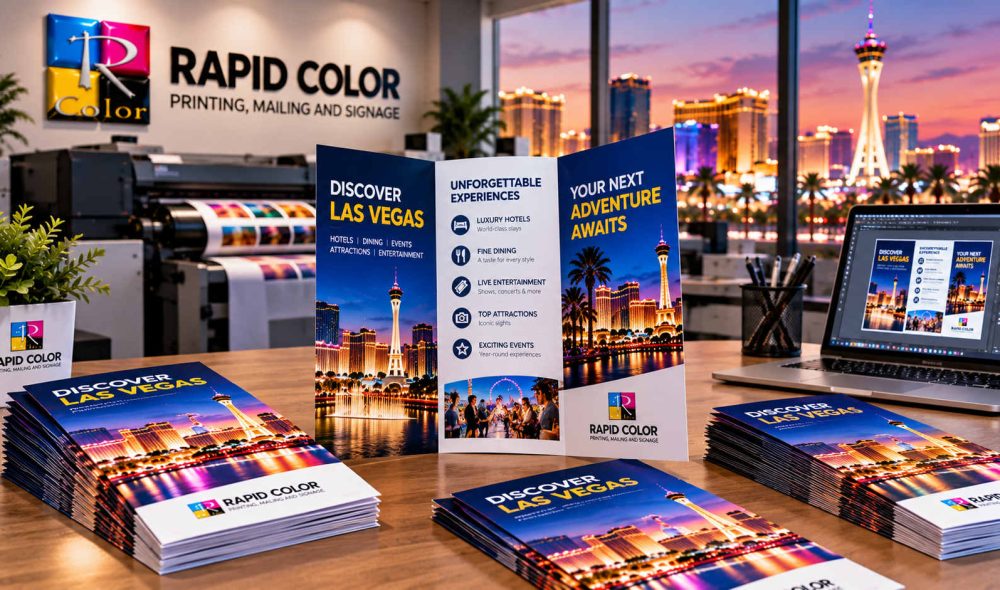
Choosing a brochure format sounds like a small design decision, but it affects how people read your message. A brochure may need to explain several services, showcase a product, or leave a polished impression after a meeting. When weighing tri-fold vs bi-fold brochures, start with the job the piece needs to do rather than choosing a fold simply because it is familiar. Rapid Color’s brochure printing in Las Vegas team can help you match the format to your content, paper, and distribution plans.
The quick answer is simple: a tri-fold is useful when you need several clearly separated sections in a compact handout. A bi-fold is often better when a larger image, a focused message, or an open inside spread deserves more space. Neither format wins every time. In 2026, the practical approach is still to plan the reader’s experience first and design the panels around it. This is the central trade-off in tri-fold vs bi-fold brochures.
What Are Tri-Fold and Bi-Fold Brochures?
A tri-fold uses two folds to divide one sheet into three panels on each side, giving you six panels in total. A bi-fold uses one fold down the middle, giving you four panels across both sides. This is the core distinction behind tri-fold vs bi-fold brochures: one creates more separate content areas, while the other provides fewer, larger surfaces.
For example, a US Letter sheet measuring 8.5 × 11 inches can fold into a bi-fold measuring approximately 8.5 × 5.5 inches when closed. A letter-fold tri-fold from the same sheet closes to a narrow panel about one-third of the sheet’s width. Exact panel widths depend on the fold and paper thickness, so ask your printer for the production template before building the artwork.
Tri-Fold vs Bi-Fold Brochures: Key Differences
The most useful way to compare is to consider how the reader will move through the information. A tri-fold can introduce a topic and reveal details panel by panel. A bi-fold opens to a wider spread, making it easier to give a photograph or central message room to breathe. That distinction is often what settles tri-fold vs bi-fold brochures for a service business. For that reason, compare tri-fold vs bi-fold brochures against the campaign’s real use.
|
Factor |
Tri-fold |
Bi-fold |
|
Panels |
6 panels across both sides |
4 panels across both sides |
|
Reading flow |
Reveals information in stages |
Opens to a broad inside spread |
|
Best content fit |
Several services, steps, or benefits |
Focused message and larger visuals |
|
Common uses |
Service handouts, rack displays, mailers |
Menus, event programs, property features |
|
Visual feel |
Compact and structured |
Open and editorial |
|
Production detail |
Tuck-in panel may need to be narrower |
Keep key content clear of the centre crease |
The table is a starting point, not a strict rule. A well-designed tri-fold can look premium, and a bi-fold can carry detailed information if the copy is edited carefully. The stronger option is the one that keeps the most important message easy to find.
When Does a Tri-Fold Brochure Make More Sense?
A tri-fold brochure is a sensible choice when readers need to scan several related details without opening a multi-page booklet. Its six panels let you give each topic a clear place, such as an introduction, service list, benefits, process, contact details, and call to action. That structure is particularly useful for businesses with more than one offering.
Good uses for a tri-fold
- Service businesses explaining several services or packages. Keep this reader experience in mind when comparing tri-fold vs bi-fold brochures.
- Trade shows, reception areas, visitor centres, and display racks where compact handouts are convenient.
- Direct-mail campaigns where the finished dimensions must suit an envelope.
- Clinics, schools, contractors, and local businesses presenting practical information in short sections.
Imagine a home-services company that wants to explain its core services, outline how bookings work, and provide contact details. A tri-fold brochure can give each part a distinct panel and guide readers toward the next step. Avoid treating every panel as space that must be filled. Short copy, useful headings, and a clear call to action are more effective than cramped paragraphs. A clear brief makes tri-fold vs bi-fold brochures easier for a printer to assess.
When Is a Bi-Fold Brochure the Better Choice?
A bi-fold brochure often works best when presentation matters more than panel count. Its larger panels can support a strong hero image, a concise brand story, or a menu with comfortable spacing. The inside spread is also useful when two related ideas need to sit side by side without being split into narrow columns.
Good uses for a bi-fold
- Restaurant and catering menus with readable categories. This practical test makes tri-fold vs bi-fold brochures easier to evaluate.
- Real estate and hospitality materials where photography helps sell the experience.
- Event programs, wedding information, and conference schedules.
- Company profiles or product introductions built around a focused message. That sequence is one reason businesses compare tri-fold vs bi-fold brochures before designing.
A bi-fold brochure should not be chosen only because it looks more spacious in a mock-up. Consider how much content you actually have and whether the reader needs a sequence of sections. If the copy becomes crowded, edit it or reconsider the format instead of shrinking the type until it is difficult to read.
How Do You Choose the Right Format for Your Campaign?
When deciding between these brochures, settle the format before the artwork is finalized. Changing the fold late can affect panel order, image crops, and the amount of copy each area can hold. These steps make the decision more straightforward.
- Define the main action. Decide whether the reader should call, book, visit a website, compare services, or keep the piece for reference. The same principle applies when weighing tri-fold vs bi-fold brochures for a local campaign.
- List the essential information. Several short topics often suit a tri-fold; a focused message or image-led story may suit a bi-fold.
- Consider the distribution method. Think about display racks, handouts, meetings, mailing envelopes, and how the brochure will be carried.
- Build a paper mock-up. Fold a blank sheet to check what readers see first and how the panels open. Use the actual reading order to judge tri-fold vs bi-fold brochures, not just the flat artwork.
- Review a full-size proof. Check the folded order, spelling, contact information, image placement, and call to action before approving the run.
Brochure Design and File Setup: Details That Matter
Good brochure design starts with the physical fold, not just a flat artboard. In a letter-fold tri-fold, the panel that tucks inside is usually slightly narrower than the other panels so it can close neatly. The exact allowance varies by paper and printer template. If all panels are made identical without checking the fold, the inside panel may buckle or the brochure may not lie flat.
Keep small text, logos, faces, and other important details away from fold lines. A photograph that crosses a crease can work well, but check the folded result to make sure the subject is not awkwardly split. Use a clear hierarchy: one main cover message, descriptive subheads, readable body copy, and one primary call to action. This is more useful than repeating the same sales point on every panel. This is worth checking early in any tri-fold vs bi-fold brochures project.
Artwork that prints to the edge usually needs bleed beyond the trim line. Follow your printer’s specifications for bleed, safe margins, image resolution, colour mode, and PDF export rather than assuming every job uses the same settings. The PRINTING United Alliance’s print-production specifications explain how industry guidelines support consistent production workflows and colour management. The final proof should confirm that tri-fold vs bi-fold brochures work as intended when folded.
Paper, Scoring, and Finishing
The right brochure paper stock should suit the way the piece will be handled and folded. A flexible text-weight paper can work well for a high-volume handout, while a heavier sheet may give a presentation piece a more substantial feel. Heavier or coated paper can crack along a crease if it is folded without suitable preparation. Ask your printer whether scoring is recommended for the selected stock and design.
Sappi’s technical guide to folding and scoring paper explains how folding places mechanical stress on paper and how scoring can help reduce cracking. This matters particularly when solid colour or images cross a fold. A short conversation about stock and scoring before production can prevent a disappointing finish. A folded paper sample can quickly clarify tri-fold vs bi-fold brochures for your audience.
Matte finishes can give a restrained look and reduce glare, while gloss can make photography and saturated colours appear more vivid. Soft-touch lamination, foil, embossing, and spot UV may add interest, but they should support the brand rather than distract from the message. Ask for samples if the feel of the finished piece is important to the campaign.
Does One Brochure Format Cost Less?
There is no universal rule that one fold costs less. Both formats can be produced from a single sheet, so the final quote often depends on quantity, finished size, paper, colour coverage, finishing, folding, and turnaround. The number of folds can affect production, but it does not tell the whole cost story.
For a useful quote, provide the finished size, quantity, paper preference, colour requirements, finish, and deadline. If the piece will be mailed, include the envelope or mailing specifications. Ask whether the quote includes a proof, artwork checks, folding, packaging, and delivery or pickup. This makes quotes easier to compare and reduces surprises. Panel spacing is a production detail that matters in tri-fold vs bi-fold brochures. This is another practical factor in choosing tri-fold vs bi-fold brochures.
Which Format Wins in 2026?
The best answer to tri-fold vs bi-fold brochures is the format that helps the reader understand your offer and take the next step. Choose a tri-fold when you need compact, organized information and a guided reading sequence. Choose a bi-fold when fewer sections, larger panels, or a strong visual spread will communicate the message more clearly.
Before ordering, sketch the content panel by panel and test it with a folded paper mock-up. If the text feels squeezed into a tri-fold, consider a bi-fold or edit the copy. If the bi-fold leaves too much unused space or forces readers to hunt for details, a tri-fold may provide better structure. For help weighing paper, folds, and finishing, explore Rapid Color’s brochure printing options or request a quote with your project details. Make the decision about tri-fold vs bi-fold brochures before approving the final artwork.
Frequently Asked Questions
1. What is the main difference between tri-fold and bi-fold brochures?
A tri-fold uses two folds to create six panels, while a bi-fold uses one fold to create four. Tri-folds separate multiple topics into compact sections; bi-folds offer larger panels and a wider inside spread. These checks help prevent avoidable problems with tri-fold vs bi-fold brochures.
2. Which brochure format is better for direct mail?
A tri-fold is often convenient for direct mail because it closes into a compact piece. Check the finished size against the envelope and mailing requirements before choosing the format or approving artwork.
3. Is a bi-fold better for photographs?
It can be. Larger panels and a continuous inside spread make it easier to feature a strong image or visual story. Keep important faces, product details, and text clear of the centre crease.
4. How many panels does a tri-fold have?
A standard tri-fold has three panels on each side of one sheet, giving six panels in total. The panel that tucks inside a letter fold is usually made slightly narrower so the brochure closes neatly. Paper choice should be part of the tri-fold vs bi-fold brochures decision from the beginning.
5. What paper is best for folded brochures?
Choose paper based on the desired feel, print coverage, durability, and fold. Heavier or coated stock may need scoring to reduce cracking, so confirm the production requirements with your printer.
6. Are tri-fold and bi-fold brochures the same price?
Not always, but the fold alone does not determine the price. Quantity, size, paper, colour coverage, finishing, folding, and turnaround can all affect the final quote.
7. Can Rapid Color help me choose a brochure format?
Yes. Share your purpose, content, quantity, size, paper preference, and deadline with Rapid Color. Those details help the team assess suitable brochure printing options and flag artwork requirements before production. A printer can explain which stock is suitable for tri-fold vs bi-fold brochures and the chosen finish.