
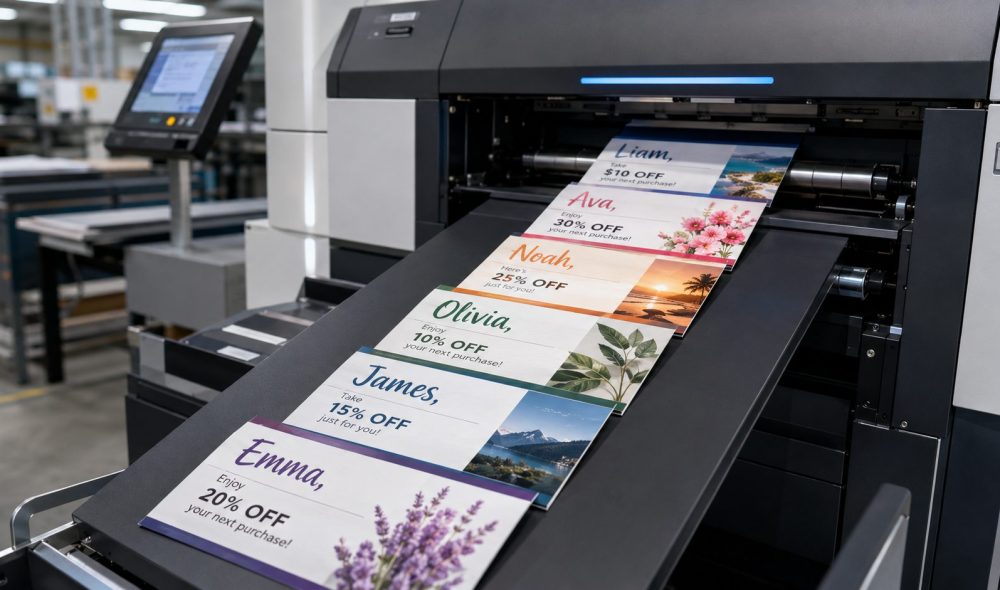
Generic mail no longer earns attention. Recipients sort their mail in seconds, and anything that looks mass-produced lands in the recycling bin before the message is read. That is why variable data printing has become one of the most powerful tools in modern marketing. Instead of printing thousands of identical pieces, this technology lets you change names, images, offers, and even entire layouts on every single piece in a run without slowing down production. The result is mail that feels written for one person rather than blasted to a list, and that difference shows up directly in your response numbers.
In this guide, the team at Rapid Color in Las Vegas breaks down how the technology works, why it outperforms static print, where it delivers the strongest return, and how to prepare a campaign that converts.
What Is Variable Data Printing and How Does It Work?
At its core, this is a digital process that connects a print file to a database. Each field in that database a first name, a city, a purchase history, a loyalty tier becomes a swappable element in the design. As pages move through the press, the software pulls fresh data for each piece and prints it on the fly. No plates need to be changed, no presses need to stop, and no two pieces have to be identical.
Traditional offset printing was never built for this. With offset, every impression comes from the same plate, so personalization meant a slow, expensive second pass. Modern VDP printing services solve that by handling everything in a single digital pass, keeping both turnaround and cost under control.
The Building Blocks: Data, Design, and Logic
A successful personalized campaign relies on three layers working together:
- Clean data: A well-organized spreadsheet or CRM export where every column is accurate, consistent, and free of duplicates. Your campaign is only as strong as the list behind it.
- Smart design: A template with defined zones that expand or shift gracefully when content changes a short name and a long name should both look intentional.
- Conditional logic: Rules that decide what each recipient sees. A lapsed customer might get a win-back coupon while a recent buyer sees a thank-you and a referral offer, all from the same print run.
Why Variable Data Digital Printing Outperforms Static Mail
The advantage of variable data digital printing is not subtle. Industry studies consistently show that personalized print pieces lift response rates well above their static counterparts. The reason is simple human psychology: people pay attention to information that clearly applies to them, and they tune out anything generic.
When you use variable data printing, you are not just adding a name to a postcard. You are matching the message, the imagery, and the call to action to what you already know about each recipient. A real estate agent can show neighborhood-specific home values. A dental office can reference the exact service a patient is due for. Each small touch compounds into a meaningful jump in conversions.
Measurable Gains You Can Expect
Marketers who switch to personalized campaigns typically report improvements across several metrics at once:
- Higher response rates because the offer feels individually relevant.
- Stronger redemption on coupons and codes tied to a specific recipient.
- Better return on ad spend, since fewer wasted impressions reach the wrong audience.
- Cleaner tracking, because unique codes and URLs reveal exactly who responded.
Ready to send mail that actually gets read? Request a free quote from Rapid Color and let our Las Vegas team show you how personalization can transform your next campaign.
Personalized Direct Mail: The Highest-Impact Use Case
Of every channel where this technology shines, mail delivers the most dramatic results. Mail is tactile, it stays in the home, and it competes against far less clutter than a crowded email inbox. Add variable data printing on top of that and you have a campaign that is both physically present and individually relevant a rare combination in advertising.
A strong personalized direct mail program does more than print a name. It segments the audience first, then tailors the creative to each segment, so the family of four receives a different message than the retired couple two streets over. Pairing this strategy with a professional direct mail printing service means the data handling, address formatting, and postal logistics are all managed under one roof.
Industries That Win with Personalized Mail
- Real estate: Hyper-local market updates and just-listed alerts tied to each neighborhood.
- Healthcare and dental: Appointment reminders and service-due notices personalized per patient.
- Automotive: Service offers based on vehicle make, model, and last visit date.
- Retail and hospitality: Birthday rewards, loyalty perks, and product recommendations.
Variable Data Postcards: Small Format, Big Returns
Postcards are the workhorse of cost-effective marketing, and personalization takes that value even further. There is no envelope to open, so your message and offer are visible the instant the recipient picks up the mail. That immediacy, combined with a name and a tailored deal, makes the format incredibly efficient.
Because variable data postcards are produced digitally, you can run multiple versions in a single batch without paying for separate print jobs. One run might contain ten neighborhood variations, three customer tiers, and a control group all printed together. When you combine this flexibility with variable data printing logic, testing becomes faster and far cheaper. Explore format options with the team’s postcard printing services to see what fits your campaign.
What You Can Personalize on a Postcard
- Recipient name in the headline and greeting.
- Images that match the recipient’s location, interest, or past purchase.
- Unique offer codes, expiration dates, and QR codes for tracking.
- Custom URLs (PURLs) that lead each recipient to a tailored landing page.
Beyond Mail: Custom Personalized Printing Across Channels
While mail gets most of the attention, this approach reaches far beyond the mailbox. The same database-driven process can power event materials, in-store signage, packaging inserts, and loyalty cards any printed item that benefits from a personal touch.
Consider a trade show: instead of a generic brochure, attendees can receive custom personalized printing that names their company and references their industry. With variable data printing, these touches scale effortlessly, so a campaign of five thousand pieces feels as personal as a handwritten note.
Popular Personalized Print Products
- Statements and invoices with targeted cross-sell messaging.
- Membership and loyalty cards with names, numbers, and tiers.
- Event badges, tickets, and welcome packets.
- Packaging inserts and thank-you cards for e-commerce orders.
Designing Personalized Marketing Materials That Convert
Great personalized marketing materials are not just technically variable they are designed with variability in mind from the first sketch. A template that looks perfect with a five-letter name can break with a fifteen-letter name. Planning for these differences is the difference between a polished campaign and an obvious mistake.
Before you launch any personalized print project, walk through this checklist so every version looks intentional:
- Build flexible text zones. Allow space for the longest realistic name, city, or offer line so nothing gets clipped or crowded.
- Standardize image dimensions. Every swappable photo should share the same crop ratio and resolution.
- Keep the hierarchy clear. The personalized element should support the offer, not fight it for attention.
- Proof every variation. Review samples from across your data short names, long names, and edge cases before the full run.
- Plan your tracking. Decide on codes, PURLs, or QR codes early so results are measurable from day one.
1 to 1 Marketing Print: The Strategy Behind the Technology
It helps to remember that this is a strategy first and a press capability second. The philosophy of 1 to 1 marketing print is to treat every recipient as an individual rather than a demographic average. The press is simply the tool that makes that philosophy affordable at scale.
Adopting this mindset changes how you build campaigns. You start with the question, “What does this person need to hear right now?” and let the data answer it. Variable data printing then executes that answer thousands of times over so one campaign can speak fluently to new prospects, loyal repeat buyers, and customers who have drifted away.
Common Mistakes to Avoid
- Dirty data: Misspelled names and outdated addresses undermine credibility instantly. Clean your list first.
- Over-personalization: Referencing information that feels invasive can backfire. Stay relevant, not creepy.
- No measurement plan: Personalization without tracking wastes its biggest advantage accountability.
How Much Do VDP Printing Services Cost?
A frequent worry is that variable data printing must cost dramatically more than a standard run. In reality, the entire job is handled digitally in one pass, so the added cost is modest usually a small premium over static digital printing, with no plate charges and no second pass.
Several factors influence the final quote:
- Quantity: Larger runs lower the per-piece cost, as with any print job.
- Complexity: Swapping a single name costs less than swapping images, offers, and layouts.
- Data condition: A clean, ready-to-use file reduces prep time and cost.
- Finishing and mailing: Coatings, folding, and postal processing add to the total.
When you weigh the modest premium against the lift in response, variable data printing almost always delivers a stronger return per dollar than a generic mailing. The campaign costs slightly more to produce but earns considerably more in results.
Want a personalized print campaign that pays for itself? Contact the Rapid Color team today for expert guidance, fast turnaround, and pricing built around your goals.
Why Las Vegas Businesses Choose Rapid Color
Rapid Color has served Las Vegas, Henderson, Summerlin, and North Las Vegas for more than three decades. That experience matters with variable data printing, because a personalized campaign depends on a partner who understands data handling, design, and postal logistics as a single connected process not three separate vendors.
From the first data review to the final mail drop, our team manages every stage in-house. We help clean and structure your list, build templates that flex gracefully, proof real variations, and coordinate the mailing so it lands on schedule. The result is a variable data printing program that is accurate, on time, and built to convert. Businesses across the Valley also rely on our broader printing services for everything from signage to packaging.
Conclusion: Make Every Piece Count
The era of one-size-fits-all marketing is over. Today’s recipients expect relevance, and they reward the brands that deliver it. Variable data printing gives you a practical, affordable way to meet that expectation turning a standard mailing into a collection of individual conversations that each speak directly to the person holding the page.
Whether you are sending a few hundred postcards or launching a multi-segment campaign, variable data printing helps you spend less on wasted impressions and earn more from the audiences that matter. With the right data, a flexible design, and an experienced print partner like Rapid Color, your next campaign can be your highest-performing one yet. Start with a clean list, a clear offer, and a conversation with our Las Vegas team.
Frequently Asked Questions
1. What is the difference between variable data printing and regular digital printing?
Regular digital printing produces identical copies of the same file. The variable-data process connects that file to a database so names, images, offers, and layouts can change on every single piece in the run without slowing down the press or requiring a second print pass.
2. Does personalized printing really increase response rates?
Yes. Industry research consistently shows personalized print pieces outperform static mail, and relevance-based offers perform even better. People pay attention to messages that clearly apply to them, so a name plus a tailored offer reliably lifts engagement and conversions.
3. How much more does a personalized campaign cost?
Usually only a modest premium over a standard digital run. Because the job is completed in one digital pass with no plate charges, the added cost is small and it is typically outweighed by the higher response the campaign generates.
4. What kind of data do I need to get started?
A clean, organized file usually a spreadsheet or CRM export with accurate names, addresses, and any fields you want to personalize. The cleaner the data, the smoother and more affordable the project. Rapid Color can help review and structure your list before printing.
5. Can postcards be personalized, or only letters?
Postcards are one of the best formats for personalization. With no envelope to open, the recipient sees the personalized message and offer immediately. Multiple versions can also be printed in a single batch, making postcards both flexible and cost-effective.
6. Is my customer data kept secure?
Reputable printers treat customer data with strict confidentiality and use it only to produce the agreed campaign. At Rapid Color, data is handled in-house under controlled processes from upload through the final mail drop.
7. How long does a personalized print campaign take?
Turnaround depends on quantity, complexity, and data readiness, but digital production keeps timelines short often comparable to a standard run. Submitting clean data and an approved, flexible design is the fastest way to stay on schedule.