
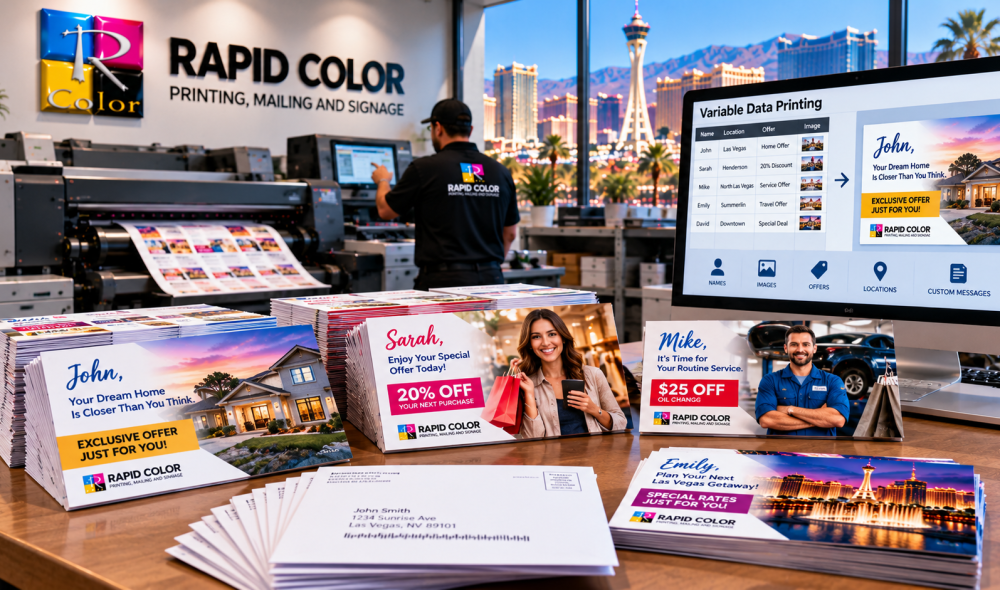
Businesses invest in marketing to reach the right audience, communicate value, and encourage customers to take action. Sending the same message to every prospect, however, may not address individual needs. Variable data printing allows selected names, images, offers, locations, and other details to change across pieces in a single production run. When paired with accurate customer data and relevant messaging, it can make campaigns more targeted and easier to measure. Rapid Color helps businesses prepare personalized postcards, mailers, and other commercial print materials.
Why Personalized Printing Matters in Modern Marketing
Personalized materials can make a campaign feel more relevant to its audience. Instead of sending identical content to everyone, marketers can adjust selected details to reflect a recipient’s location, interests, purchase history, or relationship with the business. The goal is not simply to insert a name; it is to offer information that helps the recipient understand why the message matters. This is where variable data printing can make a campaign more specific without changing its overall design.
Thoughtful personalization also supports a consistent brand experience. The layout, logo, colors, and core message can remain stable while specific content changes for different customer groups. This balance helps keep each version recognizable without making every piece identical.
What Is Variable Data Printing and How Does It Work?
This digital production method combines a database, a design template, and rules that determine which content appears on each printed piece. The overall design stays consistent, while selected elements change according to the recipient data.
For example, a retailer may feature different products for separate customer segments, a real estate company may include neighborhood-specific information, and a service provider may send offers based on relevant customer categories. One production run can contain multiple versions without requiring a separate printing plate for each variation.
The Three Essential Components
Accurate customer data: A spreadsheet or customer relationship management (CRM) export supplies the fields used for personalization. Check names, addresses, categories, and other details before production.
Flexible design templates: Artwork should accommodate changing text, images, and offers. Allow space for longer names and headlines so every version remains readable.
Personalization rules: Production software uses predefined rules to connect recipient records with the correct images, messages, offers, and calls to action.
Once the data and artwork are prepared, the printer produces the customized pieces digitally. Testing representative records before the full run helps identify formatting and data issues early. With variable data printing, teams can connect approved customer records to the correct content before production.
How Can Personalization Improve Marketing Response Rates?
Personalized content can improve relevance, but it does not guarantee a higher response rate. Results depend on audience selection, offer quality, design, timing, and how easy it is to take the next step.
Make the Message More Relevant
A message that reflects a recipient’s location or needs may be more useful than a generic promotion. For instance, a home services company could promote seasonal maintenance only to households in its service area. Use information that improves the offer rather than adding personal details without a clear purpose. Variable data printing works best when each data field has a clear purpose in the campaign.
Match Offers to Different Customer Groups
New prospects, repeat customers, and inactive customers may respond to different messages. A retailer might use an introductory offer for new customers and loyalty benefits for returning buyers. Business-to-business marketers can tailor examples or benefits to different industries while keeping the brand identity consistent.
Make Campaign Performance Easier to Measure
Unique discount codes, QR codes, and personalized URLs can help identify which audience segments respond to specific offers. Plan measurement before printing, test links and landing pages, and compare results with suitable benchmarks. This helps teams learn which messages deserve further investment.
Personalized Direct Mail: Turning Data Into Relevant Messages
Direct mail gives businesses a physical way to reach a defined audience. Personalized content can make each piece more specific without requiring a separate production run for every recipient.
Where Personalized Mail Can Be Effective
Real estate agents can share neighborhood property updates, retailers can promote offers to customer segments, automotive businesses can send service reminders, and hospitality companies can prepare targeted promotions. These are possible applications, not guaranteed outcomes; campaigns should reflect audience needs and follow applicable privacy and marketing requirements.
What to Prepare Before Printing
Confirm that mailing lists are accurate, segments are appropriate, and artwork supports every planned variation. Validate addresses, remove duplicates, standardize data formatting, and proof sample pieces. Review postal requirements before approving any mailing campaign. Before a run begins, variable data printing files should be checked for data accuracy and correct content mapping.
Variable Data Postcards for Targeted Promotions
Postcards communicate a concise message without requiring recipients to open an envelope. They can bring together an offer, a visual, and a clear call to action.
Different pieces in the same batch can feature customized greetings, location-specific information, distinct offers, or unique tracking codes. Keep the central offer easy to understand so personalization supports rather than overwhelms the design. For these examples, variable data printing should support a useful offer rather than add personalization for its own sake.
Businesses planning a postcard campaign can explore Rapid Color’s postcard printing services to consider format, quantity, design, and mailing requirements.
How to Design Personalized Marketing Materials That Work
Every variation should remain clear, visually balanced, and consistent with the brand. Identify which elements will change and which will stay fixed before artwork is finalized. Variable data printing can help keep a shared postcard design consistent while selected details change for each audience.
Plan for Every Version
Headlines, names, images, and offers must fit the layout even when variable content is longer than expected. Use consistent image dimensions, readable typography, and a clear visual hierarchy so the reader can understand the message and next step quickly.
Test the Data and Artwork Before Production
Review samples from different audience segments. Check spelling, addresses, image placement, offer conditions, QR codes, and personalized URLs. Test both typical and unusual data entries to reveal problems that may not appear in the original template. A variable data printing workflow should account for longer names, alternate images, and different offer lengths.
For more campaign preparation ideas, read Rapid Color’s direct mail printing tips.
How Much Do Personalized Print Campaigns Cost?
Costs depend on quantity, number of variations, design complexity, data preparation, paper, finishing, and mailing requirements. A job that changes only names and addresses may need less preparation than one with multiple images, offers, and layouts. Variable data printing also requires a clear review process so sample pieces represent the range of planned versions.
Digital production avoids separate printing plates for each version, but data cleaning, template development, proofing, and setup still require time. Compare complete project estimates, including finishing and mailing services, rather than looking only at unit price.
For shorter runs or frequent content changes, digital printing services may be worth considering. The best method depends on quantity, schedule, personalization needs, and desired finish.
Protect Customer Data and Maintain Accuracy
Personalized campaigns rely on customer information, so collect only the data needed, restrict access, and follow applicable laws and privacy commitments. Before transferring files to a printer, confirm how data will be transferred, accessed, used, and handled after production. When evaluating costs, variable data printing setup should be considered alongside quantity, finishing, and mailing.
The Federal Trade Commission’s guide to protecting personal information offers practical guidance for businesses developing responsible data-handling practices.
Prepare a More Effective Personalized Print Campaign
Begin with a clear objective, an appropriate audience, and an offer that gives recipients a reason to respond. Accurate data, flexible artwork, careful proofing, and a measurable call to action are equally important. Businesses using variable data printing should limit customer information to fields that are relevant to the campaign.
Rapid Color provides commercial printing and direct mail solutions for businesses that need customized marketing materials. For a project estimate, call 702-792-6055 to discuss quantity, personalization, design specifications, and mailing requirements, or visit https://rapidcolor.com/. A provider experienced with variable data printing can help confirm file requirements, proofing, and production details. For campaigns that need tailored content across a print run, variable data printing is one option to discuss with the team.
Frequently Asked Questions
1. What Is the Difference Between Variable Data Printing and Regular Digital Printing?
Regular digital printing usually produces identical copies of one design. This approach uses a database to change selected details—such as names, images, offers, or codes—across individual pieces in the same production run.
2. Does Personalization Guarantee Higher Response Rates?
No. Personalization can improve relevance, but results depend on audience quality, the offer, design, timing, and follow-up. Measure responses and compare them with previous campaigns or suitable control groups before drawing conclusions.
3. What Information Is Needed for a Personalized Print Campaign?
Requirements depend on the campaign. Common fields include names, mailing addresses, customer segments, and approved offer details. Data should be accurate, consistently formatted, and limited to what is needed.
4. Can Personalized Printing Be Used for Postcards?
Yes. Postcards can include customized greetings, location-specific offers, different images, and unique tracking codes. Test each variation and ensure the main message and call to action remain clear.
5. Is This Approach Suitable for Small Businesses?
Yes. Small businesses can use personalized postcards, targeted mailers, and customer-specific promotions. The best approach depends on available data, budget, audience size, and whether personalization justifies setup costs.
6. How Can Businesses Measure Personalized Direct Mail Results?
Track responses through discount codes, QR codes, personalized URLs, inquiries, and purchases. Compare the results with campaign costs and a suitable baseline without assuming personalization alone caused an improvement.