A product label often has less than two seconds to convince a shopper to pick up your product instead of the one next to it. Product label printing determines whether that split-second impression works in your favor, since the paper or film it’s printed on, the adhesive holding it to the container, and the finish coating all communicate quality before a customer reads a single word. Rapid Color produces product label printing for food and beverage, health and beauty, supplements, cannabis, and general consumer goods brands across Las Vegas. Choosing the right combination of material and finish is not just a design decision, it’s a practical one that affects how your product survives shipping, handling, refrigeration, and shelf life. This guide walks through the materials, adhesives, and finishes that matter most in product label printing.
Common Materials Used in Product Label Printing
Every material brings a different mix of cost, appearance, and durability to product label printing. Matching the substrate to your product’s real-world conditions is the first decision to get right.
Paper Labels
Paper stock remains the most economical substrate for product label printing and works well for dry, indoor-use products.
- Best suited to candles, dry goods, gift items, and other indoor products
- Coated paper takes ink vividly and holds up to normal handling
- Not recommended for anything exposed to moisture or refrigeration
Synthetic Film (BOPP) Labels
For products facing condensation, refrigeration, or outdoor use, most product label printing moves to synthetic film, commonly BOPP, or biaxially-oriented polypropylene.
- Naturally waterproof, tear-resistant, and dimensionally stable
- Standard choice for beverages, personal care products, and coolers or showers
- Holds sharp, vibrant color even in humid conditions
Polyester and Foil Labels
Polyester film and metallic substrates round out the most common material choices in product label printing.
- Polyester offers added chemical and UV resistance for outdoor products or labels exposed to solvents
- Metallic and foil substrates add a premium, reflective look
- Frequently chosen for spirits, cosmetics, and gift packaging where the label needs to signal a higher price point
Adhesive Options and Why They Matter
The adhesive behind a label is easy to overlook, but it determines whether your product label printing survives its intended use.
Permanent Adhesives
Permanent adhesives are the standard choice for most retail products and are designed to resist removal without damaging the label or container.
Removable Adhesives
Removable adhesives allow a label to be peeled away cleanly, useful for promotional pricing stickers or products customers may want to relabel.
Freezer-Grade Adhesives
Freezer-grade adhesives are formulated specifically to remain tacky in cold, moist conditions, which is essential for product label printing on frozen food packaging where standard adhesives can lift or peel. Specifying your product’s storage and handling conditions when ordering ensures the adhesive performs exactly as expected.
Finish Options: Gloss, Matte, and Beyond
Finish coatings shape both the look and the performance of a label, and they are where product label printing shifts from functional to genuinely eye-catching.
Gloss and Matte Lamination
- Gloss lamination produces vibrant colors and a shiny, eye-catching surface for bold retail packaging
- Matte lamination creates a softer, more sophisticated appearance for premium or natural product positioning
- Both protect against scuffing, moisture, and fading
Soft-Touch, Foil, and Spot UV
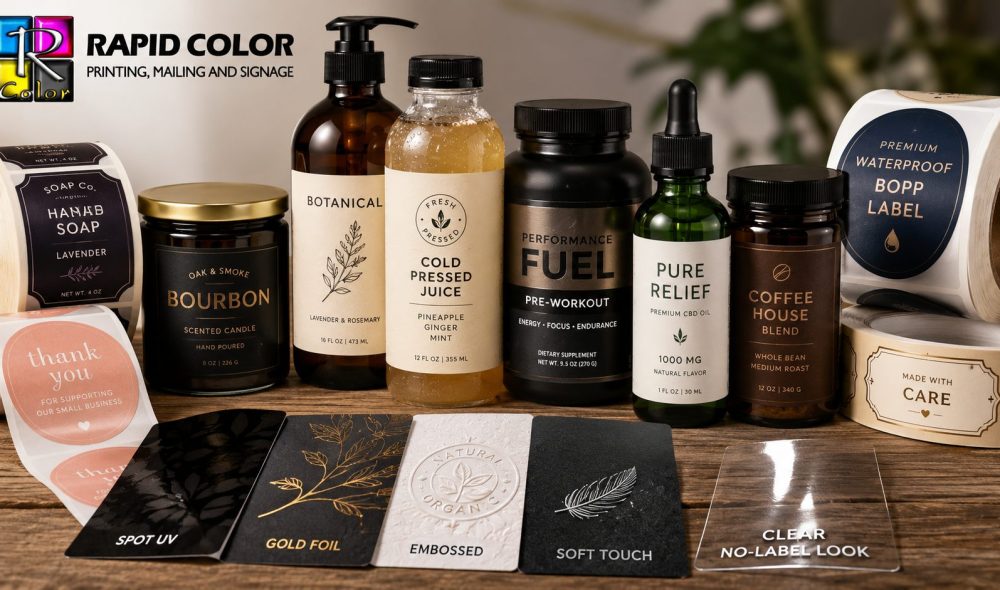
- Soft-touch lamination adds a velvet-like texture customers notice the instant they pick up the product
- Foil stamping and embossing add dimension and shine to logos or key details
- Spot UV coating creates a glossy accent against a matte background for a striking contrast
- Clear, no-label-look film lets product label printing appear to float directly on the container, popular for craft beverages and premium skincare
If you’re weighing similar decisions for other printed materials, our guide on materials and finishes for pocket folder printing walks through many of the same coating and finish trade-offs in a different format.
Choosing Materials for Specific Industries
Different industries place different demands on product label printing.
Food and Beverage
Typically requires waterproof, freezer-safe, or oil-resistant materials, along with compliance-ready space for nutritional information.
Health, Beauty, and Cosmetics
Often favors soft-touch or matte finishes that convey a premium feel and can withstand bathroom humidity.
Cannabis, CBD, and Supplements
Cannabis and CBD product label printing carries additional regulatory requirements, including specific warning statements, batch information, and child-resistant packaging compatibility. Supplement brands typically need durable, moisture-resistant labels capable of surviving repeated handling over a longer shelf life. Our digital printing supports short and long runs across all of these categories, so your product label printing can match your industry’s specific requirements without unnecessary minimums.
Variable Data and Compliance Considerations
Many products require unique information on every label. Modern product label printing handles this through variable data printing, which adds unique information to each label during a single production run rather than requiring separate print jobs. Common examples include:
- Batch codes and lot numbers
- Expiration dates
- Sequential serial numbers
- Barcodes and QR codes for traceability
This is essential for food safety traceability, regulatory compliance, and inventory tracking across large production runs. Labels can be produced on rolls for automated application equipment or on sheets for hand-applied products, in quantities ranging from a few hundred to millions.
Sustainable and Eco-Friendly Label Materials
Sustainability has become a genuine purchase driver for many consumers, and product label printing has kept pace with the shift.
- FSC-certified paper substrates come from responsibly managed forests
- Recycled-content liners reduce the waste generated by the release paper backing every label
- Water-based and soy-based inks lower environmental footprint without sacrificing color quality
- Linerless label formats eliminate the backing paper entirely to reduce material waste at scale
Common Mistakes in Product Label Printing
A surprising number of packaging problems trace back to label decisions made too late in the process. The most frequent mistakes include:
- Choosing a material without considering the product’s actual storage conditions, such as a paper label on a refrigerated beverage that wrinkles and peels within days
- Prioritizing appearance over adhesive performance, picking a striking finish without confirming it will stay attached through shipping and handling
- Submitting low-resolution or improperly formatted artwork, leading to blurry text or misregistered colors once printed at full size
- Skipping a physical proof and approving only a digital mockup before a full production run
Testing your label material under real-world conditions before committing to a full run prevents most of these costly surprises.
How to Order Product Label Printing
Getting started with product label printing is straightforward once you know what information to prepare:
- Label dimensions and the container shape and material it will be applied to
- Expected order quantity and whether labels will be applied by hand or machine
- Any regulatory or warning text that must appear on the label
- Artwork as AI or PDF with fonts embedded, images at 300 DPI, and colors in CMYK or Pantone
From there, our team recommends a substrate, adhesive, and finish based on your product’s storage and handling conditions, then provides a physical proof or sample for approval before full production begins. A label that looks correct on screen can behave very differently once applied to an actual container and exposed to real-world conditions like refrigeration or handling.
Why Work With a Local Label Printing Partner
Choosing a local Las Vegas partner for product label printing offers practical advantages that are easy to underestimate until a project is running behind schedule. A local production team can turn around proofs quickly, produce a physical sample for approval within days rather than weeks, and answer specific material questions from someone who actually runs the presses.
Rapid Color has produced labels, packaging, and print materials for Las Vegas businesses since 1989, giving our team direct experience with the material and adhesive questions that come up across food and beverage, health and beauty, and consumer goods categories. That experience means fewer surprises during your product label printing project and faster answers when your specifications change mid-process.
Get Expert Guidance on Your Product Label Printing
A material that looks perfect in a swatch book can behave very differently once it’s applied to your actual container, chilled in a cooler, or run through automated application equipment. Before finalizing an order, it helps to work through a short checklist with a packaging specialist:
- Confirm the container’s shape, texture, and curvature
- Match adhesive strength to real storage and handling conditions
- Request a physical proof rather than relying on a digital mockup alone
- Double-check that any required compliance or warning text fits the layout
Rapid Color’s packaging team walks through each of these details with you before a single label goes to press, so the finished product performs exactly as intended, whether it ends up on a shelf, in a fridge, or on a delivery truck. Reach out through our online quote form to start the conversation and request a physical sample.
Frequently Asked Questions
What material is best for waterproof product labels?
BOPP synthetic film is the standard choice for waterproof labels, resisting moisture, condensation, and tearing far better than paper stocks for refrigerated or beverage products.
What is the minimum order quantity for custom labels?
Minimums typically start around 250 to 500 units depending on material and finish selected. Contact our team for an exact quote based on your specific label size and material.
Can you print variable data like batch codes?
Yes. Our digital printing process supports variable data such as batch codes, lot numbers, and expiration dates, all within a single efficient production run.
Which finish looks most premium?
Soft-touch lamination and foil stamping are the most popular finishes for a premium feel, especially for cosmetics, spirits, and higher-end gift packaging applications overall.
Do you offer food-safe label adhesives?
Yes. We supply food-safe adhesives and substrates rated for direct food contact applications. Please specify your exact requirements when requesting a quote.
Can labels be produced on rolls for machine application?
Yes. We produce labels on rolls for automated application equipment or on sheets for hand application, in quantities ranging from a few hundred to several million.